Birdr

Least Flycatcher vs Hammond's Flycatcher

Empidonax minimus versus Empidonax hammondii

Play a quiz with Least Flycatcher and Hammond's Flycatcher
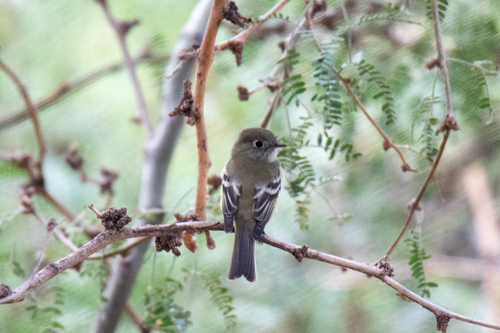
Least Flycatcher (Empidonax minimus) Least Flycatcher
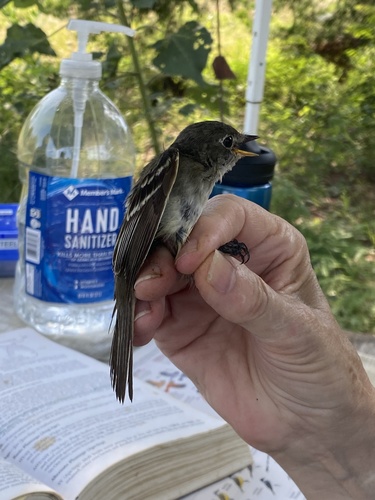
Hammond's Flycatcher (Empidonax hammondii) Hammond's Flycatcher

Media

Loading…

In short

Least Flycatcher and Hammond's Flycatcher are both small Empidonax flycatchers, making them challenging to distinguish. The Least Flycatcher is often found in deciduous or mixed forests, while Hammond's prefers mature coniferous forests. Vocalizations are a key differentiator, with the Least Flycatcher's song being more distinctive.

Identification tips

  1. Listen for vocalizations: Least Flycatcher's song is distinctive. 2. Observe habitat: Least Flycatcher in deciduous/mixed forests vs. Hammond's in coniferous forests. 3. Note behavior: Least Flycatchers are often in clusters, Hammond's are more solitary. 4. Consider location and season: Habitat preferences can guide identification.

Size

Both species are small, but the Least Flycatcher is one of the smallest Empidonax flycatchers.

Plumage

Plumage differences are subtle; both species have similar olive-gray tones, but specific plumage details are not highlighted as reliable differentiators.

Behaviour

Least Flycatchers form dense clusters of territories and are highly social during breeding. Hammond's Flycatcher is primarily an aerial forager and less social.

Habitat

Least Flycatcher breeds in deciduous or mixed forests, while Hammond's Flycatcher prefers mature and old-growth coniferous forests.

Voice

The Least Flycatcher has a distinctive song, which is a key identification feature. Hammond's Flycatcher's song and calls are similar to those of other Empidonax species, making them harder to distinguish by sound alone.

Submit a better description

Use the same sections as the comparison. Your text is published immediately.

Least Flycatcher and Hammond's Flycatcher are both small Empidonax flycatchers, making them challenging to distinguish. The Least Flycatcher is often found in deciduous or mixed forests, while Hammond's prefers mature coniferous forests. Vocalizations are a key differentiator, with the Least Flycatcher's song being more distinctive.

  1. Listen for vocalizations: Least Flycatcher's song is distinctive. 2. Observe habitat: Least Flycatcher in deciduous/mixed forests vs. Hammond's in coniferous forests. 3. Note behavior: Least Flycatchers are often in clusters, Hammond's are more solitary. 4. Consider location and season: Habitat preferences can guide identification.

Both species are small, but the Least Flycatcher is one of the smallest Empidonax flycatchers.

Plumage differences are subtle; both species have similar olive-gray tones, but specific plumage details are not highlighted as reliable differentiators.

Least Flycatchers form dense clusters of territories and are highly social during breeding. Hammond's Flycatcher is primarily an aerial forager and less social.

Least Flycatcher breeds in deciduous or mixed forests, while Hammond's Flycatcher prefers mature and old-growth coniferous forests.

The Least Flycatcher has a distinctive song, which is a key identification feature. Hammond's Flycatcher's song and calls are similar to those of other Empidonax species, making them harder to distinguish by sound alone.

Discard your changes?

You have unsaved edits. If you leave now, those changes will be lost.

Least Flycatcher · Hammond's Flycatcher · My Tricky Birds