
Least Tern vs Caspian Tern
Sternula antillarum versus Hydroprogne caspia
Play a quiz with Least Tern and Caspian Tern
 Least Tern
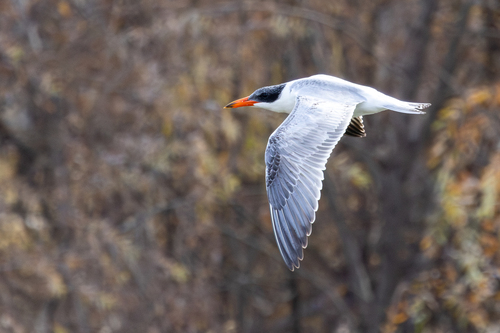 Caspian Tern
In short
The most reliable way to separate Least Tern from Caspian Tern is sheer size: Caspian is vastly larger, with a heavy, long red-orange bill, while Least is tiny and delicate with a short yellow bill. In flight, Least Tern shows a more deeply forked tail and quick, jerky wingbeats, while Caspian Tern appears broad-winged and powerful, with a less forked tail and slower, more deliberate flight. Bill color and structure, leg color, and head pattern (especially in nonbreeding plumage) also help, but beware that both show black caps and pale gray upperwings. Immature and nonbreeding birds can be confusing, so focus on size, bill, and flight style first.
Identification tips
- Size is the first check: Caspian Tern is enormous—almost gull-sized—while Least Tern is tiny, barely larger than a swallow. If you see them together, the difference is unmistakable. Even alone, Caspian's size is obvious compared to any other tern.
- Bill color and shape: Least Tern has a short, slender yellow bill with a small black tip in summer, turning blackish in winter. Caspian Tern's bill is long, thick, and bright red-orange with a small black tip, year-round. Bill size and color are visible even at a distance.
- Leg color: Least Tern has yellowish legs; Caspian Tern's legs are black. This is best seen when birds are standing.
- Tail shape: Least Tern's tail is more deeply forked and often projects beyond the wingtips at rest. Caspian Tern's tail is less forked and does not extend past the wingtips.
- Flight style: Least Tern flies with quick, jerky wingbeats and a hunched posture, bill angled down. Caspian Tern flies with slow, deep wingbeats, gliding frequently, and looks broad-winged and powerful.
- Wing pattern: Both have pale gray upperwings, but Caspian Tern's wings are broader, and the underwing shows dark primaries. Least Tern's wings are narrower with black markings on the outermost primaries.
- Head pattern (breeding): Both have a black cap, but Least Tern shows a small white forehead patch; Caspian's black cap is more extensive.
- Head pattern (nonbreeding): Least Tern's forehead becomes much whiter, reducing the black cap; Caspian Tern retains a black cap but with white streaking on the forehead.
- Body structure: Caspian Tern is thickset, heavy, and broad-winged; Least Tern is slim, delicate, and compact.
- Vocalizations: Caspian Tern's call is a loud, harsh croak; Least Tern's is a sharp, squeaky note. If you hear the call, it's a strong clue.
- Habitat context: Least Tern is usually found on sandy beaches, estuaries, and lagoons with shallow water. Caspian Tern is more widespread, often on large lakes, rivers, or coasts, sometimes far inland.
- Seasonal changes: Least Tern's bill and head pattern change between breeding and nonbreeding seasons; Caspian Tern's bill stays red-orange, and the black cap only becomes streaked in winter.
- Feeding behavior: Least Tern hovers and plunge-dives for small fish, rarely submerging. Caspian Tern also plunge-dives but with more power and often from greater heights.
- Mixed flocks: If you see both species together (rare), Caspian Tern will tower over Least Tern. In mixed colonies, Caspian is always the largest tern present.
- Juvenile confusion: No detailed juvenile wing pattern is provided here, so rely on size, bill, and structure for young birds.
Size
Caspian Tern is the world's largest tern, weighing around 634 g [wikidata], with a length of 48–60 cm and a wingspan of 127–145 cm [wikipedia]. Least Tern is the smallest North American tern, at just 22–24 cm long and a 50 cm wingspan, weighing only 39–52 g [wikipedia]. In the field, Caspian is almost gull-sized and dwarfs the sparrow-sized Least Tern. Even at a distance, the difference is dramatic: Caspian appears massive and thickset, while Least is tiny and dainty.
Plumage
Juvenile and immature plumages are not described in detail for either species in these notes, so focus is on adult and nonbreeding birds. Both species have pale gray upperwings and white underparts, but Caspian Tern's upperwings are broader and the underwings show dark primaries, especially from below. Least Tern's wings are narrower and show black markings on the outermost primaries. In breeding plumage, both have a black cap, but Least Tern has a small white forehead patch, while Caspian's black cap is more extensive. In nonbreeding (winter), Least Tern's forehead becomes much whiter, with a reduced black cap; Caspian Tern retains a black cap but with white streaking on the forehead. Bill color is key: Least Tern has a yellow bill with a small black tip (summer), turning blackish in winter; Caspian Tern's bill is thick, long, and bright red-orange with a small black tip year-round. Leg color also differs: Least Tern has yellowish legs, Caspian Tern has black legs. Tail shape is another clue: Least Tern's tail is more deeply forked and often extends beyond the wingtips at rest, while Caspian's tail is less forked and shorter relative to the wings.
Behaviour
Least Tern flies with rapid, jerky wingbeats and often looks hunched, with the bill angled slightly downward. It hovers over shallow water and plunge-dives for small fish, rarely submerging completely. Caspian Tern flies powerfully with slower, deeper wingbeats, gliding more often, and appears broad-winged and heavy. Its foraging is also over water, but it often covers greater distances and can be seen flying high and direct. Least Tern often roosts and nests on open ground, while Caspian Tern may nest singly or in colonies, sometimes with other terns and gulls.
Habitat
Least Tern breeds on sandy or gravelly beaches, estuaries, and lagoons, usually close to shallow water where small fish are abundant. Caspian Tern has a broader, more scattered distribution, breeding near large lakes, rivers, coasts, and islands, often in larger, open habitats. Both species nest on the ground, but Caspian Tern is more likely to be found inland as well as on coasts, and its colonies can be mixed with other large terns and gulls.
Voice
Caspian Tern gives a loud, harsh, heron-like croak, which is very different from the Least Tern's more squeaky calls. Least Tern's voice is higher-pitched and less harsh. If you hear a deep, croaking call from a large tern, it's Caspian; a small tern with a sharp, squeaky call is Least.