Birdr

Lesser Kestrel vs Red-footed Falcon

Falco naumanni versus Falco vespertinus

Play a quiz with Lesser Kestrel and Red-footed Falcon
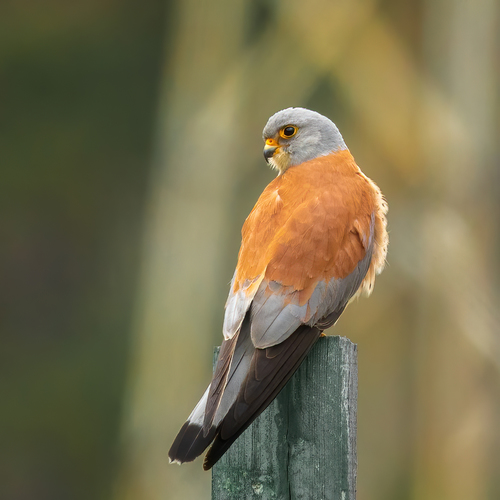
Lesser Kestrel (Falco naumanni) Lesser Kestrel
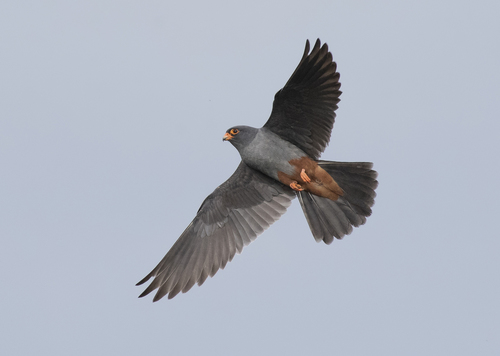
Red-footed Falcon (Falco vespertinus) Red-footed Falcon

Media

Loading…

In short

The Lesser Kestrel and Red-footed Falcon are both small falcons, but they can be distinguished by their plumage and behavior. The most reliable field mark is the male's plumage: the Lesser Kestrel male has a bluish-gray head and tail with a rusty back, while the Red-footed Falcon male is uniformly slate-gray with red legs. Both species can be found in open habitats, but their vocalizations and flight patterns also differ.

Identification tips

Size

Both species are similar in size, with the Red-footed Falcon being slightly more robust.

Plumage

Male Lesser Kestrels have a bluish-gray head and tail with a rusty back, while female and juvenile Lesser Kestrels have a more uniform brown coloration with streaking. Male Red-footed Falcons are uniformly slate-gray with red legs, and females have a striking combination of gray and orange plumage with a pale head. Juvenile Red-footed Falcons are brown with a paler face, making them more similar to female Lesser Kestrels.

Behaviour

Lesser Kestrels often hover while hunting, a behavior less commonly seen in Red-footed Falcons, which tend to hunt from perches or in flight.

Habitat

Both species prefer open habitats, but Lesser Kestrels are more commonly found in agricultural areas, while Red-footed Falcons are often seen in steppe and open woodland.

Voice

Lesser Kestrels have a distinctive 'klee-klee-klee' call, while Red-footed Falcons are generally quieter, with softer, less frequent calls.

Submit a better description

Use the same sections as the comparison. Your text is published immediately.

The Lesser Kestrel and Red-footed Falcon are both small falcons, but they can be distinguished by their plumage and behavior. The most reliable field mark is the male's plumage: the Lesser Kestrel male has a bluish-gray head and tail with a rusty back, while the Red-footed Falcon male is uniformly slate-gray with red legs. Both species can be found in open habitats, but their vocalizations and flight patterns also differ.

  • Male plumage: Look for the uniform slate-gray of the male Red-footed Falcon versus the rusty back and bluish-gray head of the male Lesser Kestrel.
  • Female and juvenile plumage: Note the pale head and orange tones in female Red-footed Falcons, which differ from the streaked brown of female Lesser Kestrels.
  • Behavior: Observe hunting behavior; Lesser Kestrels hover more frequently.
  • Vocalizations: Listen for the 'klee-klee-klee' of the Lesser Kestrel.
  • Habitat: Consider the habitat; Lesser Kestrels are more associated with agricultural areas.

Both species are similar in size, with the Red-footed Falcon being slightly more robust.

Male Lesser Kestrels have a bluish-gray head and tail with a rusty back, while female and juvenile Lesser Kestrels have a more uniform brown coloration with streaking. Male Red-footed Falcons are uniformly slate-gray with red legs, and females have a striking combination of gray and orange plumage with a pale head. Juvenile Red-footed Falcons are brown with a paler face, making them more similar to female Lesser Kestrels.

Lesser Kestrels often hover while hunting, a behavior less commonly seen in Red-footed Falcons, which tend to hunt from perches or in flight.

Both species prefer open habitats, but Lesser Kestrels are more commonly found in agricultural areas, while Red-footed Falcons are often seen in steppe and open woodland.

Lesser Kestrels have a distinctive 'klee-klee-klee' call, while Red-footed Falcons are generally quieter, with softer, less frequent calls.

Discard your changes?

You have unsaved edits. If you leave now, those changes will be lost.

Lesser Kestrel · Red-footed Falcon · My Tricky Birds