
Birdr

Lesser Yellowlegs vs Greater Yellowlegs

Tringa flavipes versus Tringa melanoleuca

Play a quiz with Lesser Yellowlegs and Greater Yellowlegs
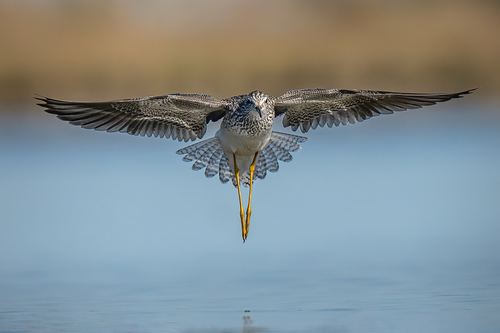
Lesser Yellowlegs (Tringa flavipes) Lesser Yellowlegs
Greater Yellowlegs (Tringa melanoleuca) Greater Yellowlegs

Media

Loading…

In short

The most reliable field mark between Lesser and Greater Yellowlegs is the bill: Lesser's bill is slim, straight, and about the same length as its head, while Greater's bill is noticeably longer than the head and often slightly upturned. Both species are similar in plumage and share bright yellow legs, but Greater Yellowlegs is much bulkier, with a heavier build and a coarser, darker breast pattern in breeding plumage. Voice is also a strong separator—Greater's call is much louder and clearer. Immature and adult birds can be tricky, especially in non-breeding plumage, but careful attention to bill length and structure, size, and vocalizations will resolve most field confusion.

Identification tips

  1. Bill length and shape: On Lesser Yellowlegs, the bill is about the same length as the head, slim, straight, and uniformly dark. On Greater, the bill is noticeably longer than the head and often slightly upturned; it also appears heavier. This is the most reliable field mark in all ages and seasons.
  2. Relative size and bulk: Greater Yellowlegs is almost twice as heavy as Lesser. When seen together, Greater looks much larger and more robust. Alone, look for a heavier body, longer neck, and longer legs on Greater.
  3. Breast pattern in breeding plumage: Greater shows coarser, darker, and more extensive streaking and barring on the breast and flanks, while Lesser's markings are finer and more limited. This is best seen at close range in spring/summer.
  4. Neck and jizz: Greater stands taller and more upright, with a longer neck and a more elongated appearance. Lesser appears more delicate, with a shorter neck and a lighter build.
  5. Leg color: Both have bright yellow legs, so this is not a separator.
  6. Voice: Greater's call is much louder, clearer, and more ringing, often a three-note whistle. Lesser's call is softer and less piercing. Use voice when birds are flushed or calling in flight.
  7. Bill color and pattern: Both species have dark bills, but Greater's may show a slight two-tone effect (darker tip), though this is subtle and unreliable.
  8. Feeding behavior: Both species forage actively, but Greater may use its longer bill to stir water more often. This is a minor clue.
  9. Plumage in non-breeding and juvenile birds: Both are similar—grey-brown above, white below, with streaked necks. No strong flight or wing pattern differences are described, so rely on structure and bill.
  10. Flank markings: In breeding plumage, Greater has more extensive barring on the flanks; Lesser's flanks are more finely marked.
  11. Tail and rump: Both have white rumps and tails; not a separator.
  12. Habitat and context: Both use similar habitats throughout the year; do not rely on location alone.
  13. Group behavior: When mixed, Greater may appear more dominant and upright, but this is subtle.
  14. Sex and age: Sexes are similar in both species; age differences are not strongly diagnostic except for the slightly finer markings on young Lessers.
  15. When in doubt: If you cannot judge size or bill length (e.g., distant birds), wait for a call or look for direct comparison with other shorebirds.

Size

Greater Yellowlegs is significantly larger and heavier than Lesser Yellowlegs: adults average about 170 g compared to Lesser's 81 g. In the field, Greater appears longer-bodied (29–40 cm vs. 23–25 cm), with a more robust, upright stance. Lesser Yellowlegs looks more delicate and slim, with a shorter neck and body. When the two are together, the size difference is obvious, but when alone, use bill length and overall bulk as your main clues.

Plumage

Juvenile and non-breeding plumages are quite similar between the two, with both showing grey-brown upperparts and white underparts. In breeding plumage, both have streaked necks and breasts, but Greater Yellowlegs shows coarser, darker, and more extensive streaking and barring, especially on the breast and flanks, while Lesser's markings are finer and more limited. Both have white rumps and yellow legs. There are no distinctive age-specific upperwing patterns or flight marks described for either species that reliably separate them in flight, so structure and bill remain key. Sexes are similar in both species.

Behaviour

Both forage actively in shallow water, often moving quickly with high-stepping gaits. Greater Yellowlegs may use its longer bill to stir water more frequently. Lesser Yellowlegs tends to look more delicate and moves with a lighter, more graceful gait. Both species are often found singly or in small groups, sometimes together, but Greater Yellowlegs can appear more dominant and upright.

Habitat

Habitat overlap is extensive: both species breed in northern North America and winter across a wide range from the southern US to South America. Both prefer shallow wetlands, mudflats, and marshes. There is no strong habitat separation in migration or wintering grounds, so context is not usually helpful for identification.

Voice

Greater Yellowlegs has a much louder, clearer, and more ringing call, often a three-syllable whistle with a lower-pitched third note. Lesser Yellowlegs gives a softer, less piercing call. Voice is one of the best field separators, especially when birds are flushed or calling in flight.

Submit a better description

Use the same sections as the comparison. Your text is published immediately.

The most reliable field mark between Lesser and Greater Yellowlegs is the bill: Lesser's bill is slim, straight, and about the same length as its head, while Greater's bill is noticeably longer than the head and often slightly upturned. Both species are similar in plumage and share bright yellow legs, but Greater Yellowlegs is much bulkier, with a heavier build and a coarser, darker breast pattern in breeding plumage. Voice is also a strong separator—Greater's call is much louder and clearer. Immature and adult birds can be tricky, especially in non-breeding plumage, but careful attention to bill length and structure, size, and vocalizations will resolve most field confusion.

  1. Bill length and shape: On Lesser Yellowlegs, the bill is about the same length as the head, slim, straight, and uniformly dark. On Greater, the bill is noticeably longer than the head and often slightly upturned; it also appears heavier. This is the most reliable field mark in all ages and seasons.
  2. Relative size and bulk: Greater Yellowlegs is almost twice as heavy as Lesser. When seen together, Greater looks much larger and more robust. Alone, look for a heavier body, longer neck, and longer legs on Greater.
  3. Breast pattern in breeding plumage: Greater shows coarser, darker, and more extensive streaking and barring on the breast and flanks, while Lesser's markings are finer and more limited. This is best seen at close range in spring/summer.
  4. Neck and jizz: Greater stands taller and more upright, with a longer neck and a more elongated appearance. Lesser appears more delicate, with a shorter neck and a lighter build.
  5. Leg color: Both have bright yellow legs, so this is not a separator.
  6. Voice: Greater's call is much louder, clearer, and more ringing, often a three-note whistle. Lesser's call is softer and less piercing. Use voice when birds are flushed or calling in flight.
  7. Bill color and pattern: Both species have dark bills, but Greater's may show a slight two-tone effect (darker tip), though this is subtle and unreliable.
  8. Feeding behavior: Both species forage actively, but Greater may use its longer bill to stir water more often. This is a minor clue.
  9. Plumage in non-breeding and juvenile birds: Both are similar—grey-brown above, white below, with streaked necks. No strong flight or wing pattern differences are described, so rely on structure and bill.
  10. Flank markings: In breeding plumage, Greater has more extensive barring on the flanks; Lesser's flanks are more finely marked.
  11. Tail and rump: Both have white rumps and tails; not a separator.
  12. Habitat and context: Both use similar habitats throughout the year; do not rely on location alone.
  13. Group behavior: When mixed, Greater may appear more dominant and upright, but this is subtle.
  14. Sex and age: Sexes are similar in both species; age differences are not strongly diagnostic except for the slightly finer markings on young Lessers.
  15. When in doubt: If you cannot judge size or bill length (e.g., distant birds), wait for a call or look for direct comparison with other shorebirds.

Greater Yellowlegs is significantly larger and heavier than Lesser Yellowlegs: adults average about 170 g compared to Lesser's 81 g. In the field, Greater appears longer-bodied (29–40 cm vs. 23–25 cm), with a more robust, upright stance. Lesser Yellowlegs looks more delicate and slim, with a shorter neck and body. When the two are together, the size difference is obvious, but when alone, use bill length and overall bulk as your main clues.

Juvenile and non-breeding plumages are quite similar between the two, with both showing grey-brown upperparts and white underparts. In breeding plumage, both have streaked necks and breasts, but Greater Yellowlegs shows coarser, darker, and more extensive streaking and barring, especially on the breast and flanks, while Lesser's markings are finer and more limited. Both have white rumps and yellow legs. There are no distinctive age-specific upperwing patterns or flight marks described for either species that reliably separate them in flight, so structure and bill remain key. Sexes are similar in both species.

Both forage actively in shallow water, often moving quickly with high-stepping gaits. Greater Yellowlegs may use its longer bill to stir water more frequently. Lesser Yellowlegs tends to look more delicate and moves with a lighter, more graceful gait. Both species are often found singly or in small groups, sometimes together, but Greater Yellowlegs can appear more dominant and upright.

Habitat overlap is extensive: both species breed in northern North America and winter across a wide range from the southern US to South America. Both prefer shallow wetlands, mudflats, and marshes. There is no strong habitat separation in migration or wintering grounds, so context is not usually helpful for identification.

Greater Yellowlegs has a much louder, clearer, and more ringing call, often a three-syllable whistle with a lower-pitched third note. Lesser Yellowlegs gives a softer, less piercing call. Voice is one of the best field separators, especially when birds are flushed or calling in flight.

Discard your changes?

You have unsaved edits. If you leave now, those changes will be lost.

Lesser Yellowlegs · Greater Yellowlegs · My Tricky Birds