Birdr

Little Bee-eater vs Swallow-tailed Bee-eater

Merops pusillus versus Merops hirundineus

Play a quiz with Little Bee-eater and Swallow-tailed Bee-eater
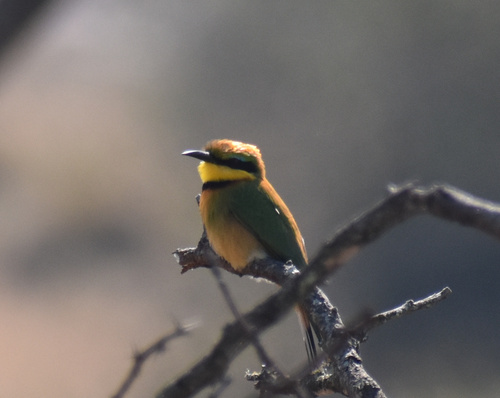
Little Bee-eater (Merops pusillus) Little Bee-eater
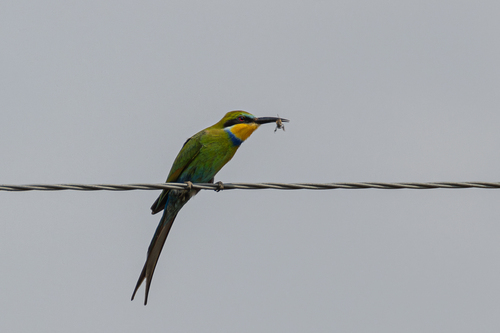
Swallow-tailed Bee-eater (Merops hirundineus) Swallow-tailed Bee-eater

Media

Loading…

In short

The Little Bee-eater (Merops pusillus) and Swallow-tailed Bee-eater (Merops hirundineus) are both small, colorful bee-eaters, but they can be distinguished by tail shape and plumage details. The Swallow-tailed Bee-eater has a distinctive forked tail, while the Little Bee-eater has a shorter, more rounded tail. Both species share similar habitats and behaviors, but their vocalizations and specific plumage features can aid in identification.

Identification tips

  1. Look for the forked tail of the Swallow-tailed Bee-eater versus the rounded tail of the Little Bee-eater. 2. Note the throat color: yellow in Little Bee-eater, blue in Swallow-tailed Bee-eater. 3. Consider the eye stripe: both have it, but it is more pronounced in the Little Bee-eater. 4. Observe the habitat and behavior, but rely on plumage and tail shape for definitive ID.

Size

Both species are similar in size, but the Swallow-tailed Bee-eater appears slightly larger due to its longer tail.

Plumage

The Little Bee-eater has a bright green back and yellow throat with a black eye stripe. The Swallow-tailed Bee-eater also has a green back but features a blue throat and a more pronounced forked tail. Both have colorful plumage, but the throat color and tail shape are key differences.

Behaviour

Both species exhibit similar behaviors, such as sallying from perches to catch insects in flight. They often perch conspicuously and are social, sometimes seen in small groups.

Habitat

Both species inhabit open woodlands, savannas, and areas near water. They can often be found in similar environments, making habitat alone an unreliable differentiator.

Voice

Vocalizations are not distinctly different enough to reliably separate these species in the field without prior experience.

Submit a better description

Use the same sections as the comparison. Your text is published immediately.

The Little Bee-eater (Merops pusillus) and Swallow-tailed Bee-eater (Merops hirundineus) are both small, colorful bee-eaters, but they can be distinguished by tail shape and plumage details. The Swallow-tailed Bee-eater has a distinctive forked tail, while the Little Bee-eater has a shorter, more rounded tail. Both species share similar habitats and behaviors, but their vocalizations and specific plumage features can aid in identification.

  1. Look for the forked tail of the Swallow-tailed Bee-eater versus the rounded tail of the Little Bee-eater. 2. Note the throat color: yellow in Little Bee-eater, blue in Swallow-tailed Bee-eater. 3. Consider the eye stripe: both have it, but it is more pronounced in the Little Bee-eater. 4. Observe the habitat and behavior, but rely on plumage and tail shape for definitive ID.

Both species are similar in size, but the Swallow-tailed Bee-eater appears slightly larger due to its longer tail.

The Little Bee-eater has a bright green back and yellow throat with a black eye stripe. The Swallow-tailed Bee-eater also has a green back but features a blue throat and a more pronounced forked tail. Both have colorful plumage, but the throat color and tail shape are key differences.

Both species exhibit similar behaviors, such as sallying from perches to catch insects in flight. They often perch conspicuously and are social, sometimes seen in small groups.

Both species inhabit open woodlands, savannas, and areas near water. They can often be found in similar environments, making habitat alone an unreliable differentiator.

Vocalizations are not distinctly different enough to reliably separate these species in the field without prior experience.

Discard your changes?

You have unsaved edits. If you leave now, those changes will be lost.

Little Bee-eater · Swallow-tailed Bee-eater · My Tricky Birds