
Little Bittern vs Striated Heron
Botaurus minutus versus Butorides striata
Play a quiz with Little Bittern and Striated Heron
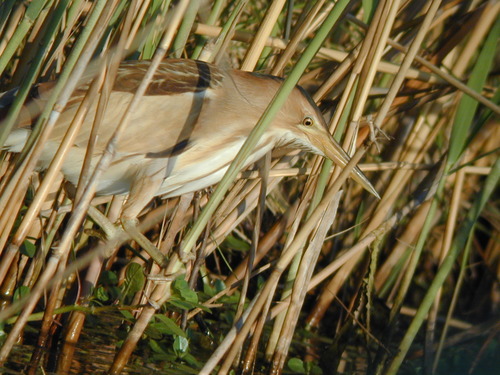 Little Bittern
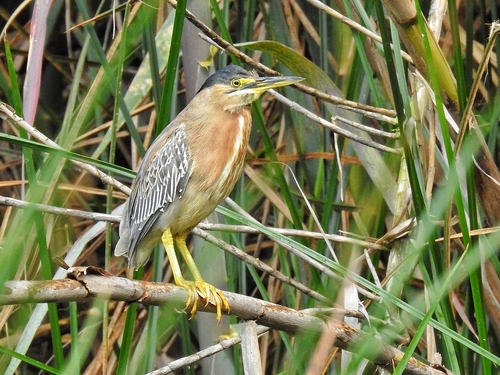 Striated Heron
In short
The most reliable field mark to separate Little Bittern from Striated Heron is the presence of a pale or pinkish-buff forewing panel on Little Bitterns of all ages, especially obvious in flight and on perched males, while Striated Heron shows uniform blue-grey wings without any pale panel. Juvenile Little Bitterns are more rufous and heavily streaked above and below, with streaked wing coverts, whereas juvenile Striated Herons are browner above but also heavily streaked below. Structurally, Little Bittern is distinctly smaller, more compact, and has a thicker neck and shorter legs compared to the longer, more horizontal Striated Heron. Both species can be secretive, but their size, wing pattern, and posture offer consistent separation, especially in flight or at rest.
Identification tips
- Pale/pinkish-buff forewing panel (Little Bittern): Look for a pale or pinkish-buff oval patch on the inner wing coverts, visible in flight and on perched birds, especially males. This is absent in Striated Heron of all ages and sexes.
- Uniform blue-grey wings (Striated Heron): Striated Heron always shows uniform blue-grey upperwings with no pale panel, regardless of age or sex.
- Juvenile streaking: Both species' juveniles are heavily streaked below, but Little Bittern juveniles are more rufous and streaked above and on the wing coverts, while Striated Heron juveniles are browner above and lack the rufous tones.
- Adult male plumage: Little Bittern males have a glossy black crown, nape, and back, with pale buff underparts and a strong wing panel. Striated Heron adults (both sexes) have a black cap, blue-grey back and wings, and white underparts, sometimes tinged with pink or orange.
- Sexual dimorphism: Only Little Bittern shows obvious male/female differences; Striated Heron sexes are alike.
- Underwing color: In flight, Little Bittern shows a completely whitish underwing, which can be seen in good light; Striated Heron underwing is not described as contrastingly pale.
- Size and structure: Little Bittern is smaller, more compact, with a thicker neck and shorter legs. Striated Heron is longer, stands taller, and has proportionally longer legs and a more horizontal stance.
- Bill shape: Both have long, sharp bills, but Little Bittern's is thicker at the base and shorter overall, matching its compact structure.
- Posture: Little Bittern often adopts a vertical, neck-extended freeze posture in reeds; Striated Heron is more likely to be seen perched horizontally or actively foraging.
- Habitat: In Europe, Little Bittern is found in dense freshwater reedbeds; Striated Heron prefers mangroves and tidal creeks in its main range.
- Seasonality: Little Bittern is migratory in Europe, present mainly April–September; Striated Heron is mostly sedentary in its range.
- Leg color: Striated Heron has short yellow legs, which may be visible on perched birds; Little Bittern's leg color is less distinctive in the field.
- Facial pattern: Striated Heron shows a dark line from bill to under eye; Little Bittern lacks this mark.
- Streaking on underparts: Little Bittern females and juveniles are streaked below, but the pattern is denser and more rufous than the brown streaking of Striated Heron juveniles.
- Flight jizz: Little Bittern appears short-winged and compact in flight, with a strong pale panel; Striated Heron looks longer-winged and more uniformly colored.
Size
Little Bittern is the smallest breeding heron in Europe, with a body mass around 147 g, a length of 33–38 cm, and a wingspan of 52–58 cm. Striated Heron is larger and bulkier, with a length of 35–48 cm and a wingspan of 52–60 cm (body mass 130–250 g, but usually heavier than Little Bittern). In the field, Little Bittern appears noticeably more petite, with a shorter, thicker neck and a more compact body, while Striated Heron stands taller and longer, with proportionally longer legs and a more elongated posture.
Plumage
-
Juvenile/immature birds: Little Bittern juveniles are duller and more rufous than females, with heavy streaking on both upperparts and underparts, including the wing coverts. The pale or pinkish-buff wing panel is still present but less obvious than in adult males. Striated Heron juveniles are browner above and also heavily streaked below, but lack any pale wing panel; their wings are uniformly dark or blue-grey.
-
Adult males: Little Bittern males have a striking black crown, nape, back, tail, and scapulars with a faint green sheen, pale buff underparts, and a prominent pinkish-buff oval wing panel formed by the inner coverts. The underwing is completely whitish. Striated Heron adults have a blue-grey back and wings, a black cap, white underparts (sometimes tinged pinkish or orangey), and a dark line from bill to under eye, but no pale wing panel.
-
Adult females: Little Bittern females are duller, with brownish-black upperparts and paler feather margins, streaked underparts, and a less obvious pale wing panel. Striated Heron females are not separable from males in plumage; both sexes look alike.
-
Flight: The pale forewing panel of Little Bittern is a key mark in flight at all ages, contrasting with the otherwise dark wings. Striated Heron shows uniform blue-grey wings in flight, with no panel.
Behaviour
Little Bittern is more secretive and skulking, often moving through dense reedbeds with a hunched posture and rarely seen in the open. It tends to freeze with its bill pointed upward when alarmed. Striated Heron is also wary but more likely to be seen perched openly on mangrove roots or branches, often adopting a horizontal stance. Both species can freeze when disturbed, but Striated Heron may show more active foraging behavior, including fishing from perches and occasionally displaying unique nest behaviors (such as the 'sewing machine' head motion).
Habitat
Little Bittern breeds in dense reedbeds and freshwater wetlands, especially in Europe, and is migratory, leaving most sites by October. Striated Heron is more associated with mangroves, riverbanks, and coastal wetlands, especially in South America and the Caribbean, and is mostly sedentary. In Europe, finding a Striated Heron is rare, while Little Bittern is a regular summer breeder. Habitat context can help: dense inland reeds for Little Bittern, open mangroves or tidal creeks for Striated Heron.