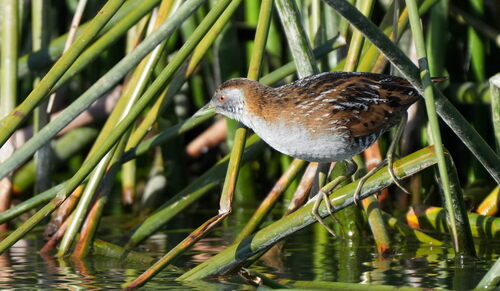
Little Crake vs Baillon's Crake
Zapornia parva versus Zapornia pusilla
Play a quiz with Little Crake and Baillon's Crake
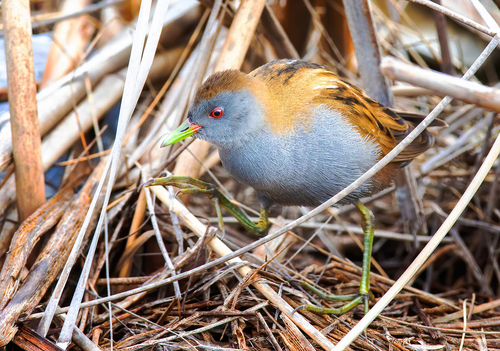
Little Crake
Baillon's Crake
In short
The Little Crake and Baillon's Crake are small, elusive waterbirds that can be difficult to differentiate in the field. The most reliable field mark is the undertail coverts: Little Crake has white undertail coverts, while Baillon's Crake has barred undertail coverts. Both species are similar in size and structure, but subtle differences in plumage and habitat preference can aid identification.
Identification tips
- Check undertail coverts: Little Crake has white, Baillon's Crake has barred.
- Listen for calls: Little Crake's 'kek' vs. Baillon's 'prrrt'.
- Observe habitat: Little Crake in more open water, Baillon's in denser vegetation.
- Note plumage: Little Crake is more uniform grey-brown, Baillon's is more barred.
Size
Both species are similar in size, with Little Crake being slightly larger but this is not easily noticeable in the field.
Plumage
Little Crake has a more uniform greyish-brown plumage with a distinctive white undertail. Baillon's Crake has a more barred and mottled appearance, especially on the flanks and undertail coverts.
Behaviour
Both species are secretive and often seen skulking in dense vegetation. Little Crake may be slightly more likely to venture into open water.
Habitat
Little Crake prefers reedbeds and marshes with more open water, while Baillon's Crake is often found in denser, more vegetated wetlands.
Voice
Little Crake's call is a series of 'kek' notes, while Baillon's Crake has a more varied call with a distinctive 'prrrt' sound. Vocalizations are a useful differentiator if heard.