Birdr

Little Cuckoo-Dove vs Nicobar Pigeon

Macropygia ruficeps versus Caloenas nicobarica

Play a quiz with Little Cuckoo-Dove and Nicobar Pigeon
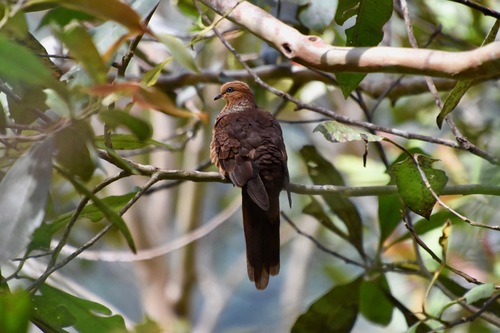
Little Cuckoo-Dove (Macropygia ruficeps) Little Cuckoo-Dove
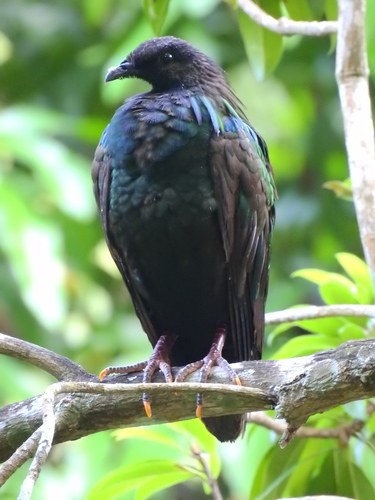
Nicobar Pigeon (Caloenas nicobarica) Nicobar Pigeon

Media

Loading…

In short

The Little Cuckoo-Dove and Nicobar Pigeon are distinct in both size and appearance. The Nicobar Pigeon is notably larger with iridescent plumage, while the Little Cuckoo-Dove is smaller and more uniformly colored. Observing size and plumage are the most reliable ways to differentiate these species.

Identification tips

  1. Size: Look for the larger size of the Nicobar Pigeon. 2. Plumage: Note the iridescent feathers of the Nicobar Pigeon compared to the plain brown of the Little Cuckoo-Dove. 3. Habitat: Consider the location; Nicobar Pigeons are more likely on islands and coastal areas, while Little Cuckoo-Doves prefer forested regions. 4. Behavior: Observe the behavior; Nicobar Pigeons may be seen in groups, unlike the more solitary Little Cuckoo-Dove.

Size

The Nicobar Pigeon is significantly larger than the Little Cuckoo-Dove.

Plumage

The Nicobar Pigeon has striking iridescent feathers with a metallic sheen, especially on the neck and wings. In contrast, the Little Cuckoo-Dove has a more subdued, uniform brownish plumage without iridescence.

Behaviour

The Nicobar Pigeon often forages on the ground and can be seen in flocks, while the Little Cuckoo-Dove is more solitary and may be observed perching quietly.

Habitat

The Nicobar Pigeon is typically found on small islands and coastal areas, often near forests. The Little Cuckoo-Dove inhabits forested areas, often at higher elevations.

Voice

Specific vocalization details are not well-documented for either species, but the Little Cuckoo-Dove is generally quieter and less vocal than the Nicobar Pigeon.

Submit a better description

Use the same sections as the comparison. Your text is published immediately.

The Little Cuckoo-Dove and Nicobar Pigeon are distinct in both size and appearance. The Nicobar Pigeon is notably larger with iridescent plumage, while the Little Cuckoo-Dove is smaller and more uniformly colored. Observing size and plumage are the most reliable ways to differentiate these species.

  1. Size: Look for the larger size of the Nicobar Pigeon. 2. Plumage: Note the iridescent feathers of the Nicobar Pigeon compared to the plain brown of the Little Cuckoo-Dove. 3. Habitat: Consider the location; Nicobar Pigeons are more likely on islands and coastal areas, while Little Cuckoo-Doves prefer forested regions. 4. Behavior: Observe the behavior; Nicobar Pigeons may be seen in groups, unlike the more solitary Little Cuckoo-Dove.

The Nicobar Pigeon is significantly larger than the Little Cuckoo-Dove.

The Nicobar Pigeon has striking iridescent feathers with a metallic sheen, especially on the neck and wings. In contrast, the Little Cuckoo-Dove has a more subdued, uniform brownish plumage without iridescence.

The Nicobar Pigeon often forages on the ground and can be seen in flocks, while the Little Cuckoo-Dove is more solitary and may be observed perching quietly.

The Nicobar Pigeon is typically found on small islands and coastal areas, often near forests. The Little Cuckoo-Dove inhabits forested areas, often at higher elevations.

Specific vocalization details are not well-documented for either species, but the Little Cuckoo-Dove is generally quieter and less vocal than the Nicobar Pigeon.

Discard your changes?

You have unsaved edits. If you leave now, those changes will be lost.

Little Cuckoo-Dove · Nicobar Pigeon · My Tricky Birds