Birdr

Little Green-Pigeon vs Orange-breasted Green-Pigeon

Treron olax versus Treron bicinctus

Play a quiz with Little Green-Pigeon and Orange-breasted Green-Pigeon

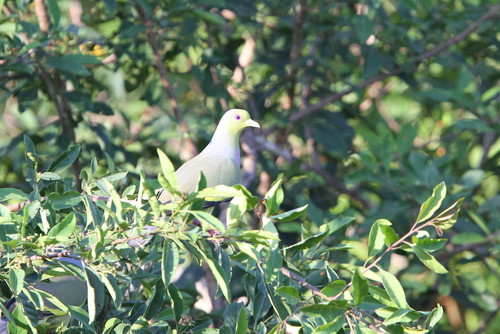
Little Green-Pigeon (Treron olax) Little Green-Pigeon
Orange-breasted Green-Pigeon (Treron bicinctus) Orange-breasted Green-Pigeon

Media

Loading…

In short

The Little Green-Pigeon and the Orange-breasted Green-Pigeon are both small, greenish pigeons, but they can be distinguished by their plumage details and habitat preferences. The Orange-breasted Green-Pigeon typically shows a more pronounced orange breast band, while the Little Green-Pigeon lacks this feature. Observing their preferred habitats can also aid in identification.

Identification tips

  1. Look for the orange breast band on the Orange-breasted Green-Pigeon. 2. Note the habitat: denser forests suggest Little Green-Pigeon, while open woodlands suggest Orange-breasted. 3. Observe overall plumage: more uniform green indicates Little Green-Pigeon.

Size

Both species are similar in size, typical of small green-pigeons.

Plumage

The Orange-breasted Green-Pigeon has a distinctive orange band across the breast, which is absent in the Little Green-Pigeon. The Little Green-Pigeon generally appears more uniformly green without the contrasting orange breast.

Behaviour

Both species exhibit similar behaviors typical of green-pigeons, such as perching quietly in trees and feeding on fruits.

Habitat

The Orange-breasted Green-Pigeon is often found in more open woodlands and edges, while the Little Green-Pigeon prefers denser forests. Observing the surrounding environment can provide clues to their identity.

Voice

Vocalizations are not well-documented for field differentiation, but both species have typical pigeon coos.

Submit a better description

Use the same sections as the comparison. Your text is published immediately.

The Little Green-Pigeon and the Orange-breasted Green-Pigeon are both small, greenish pigeons, but they can be distinguished by their plumage details and habitat preferences. The Orange-breasted Green-Pigeon typically shows a more pronounced orange breast band, while the Little Green-Pigeon lacks this feature. Observing their preferred habitats can also aid in identification.

  1. Look for the orange breast band on the Orange-breasted Green-Pigeon. 2. Note the habitat: denser forests suggest Little Green-Pigeon, while open woodlands suggest Orange-breasted. 3. Observe overall plumage: more uniform green indicates Little Green-Pigeon.

Both species are similar in size, typical of small green-pigeons.

The Orange-breasted Green-Pigeon has a distinctive orange band across the breast, which is absent in the Little Green-Pigeon. The Little Green-Pigeon generally appears more uniformly green without the contrasting orange breast.

Both species exhibit similar behaviors typical of green-pigeons, such as perching quietly in trees and feeding on fruits.

The Orange-breasted Green-Pigeon is often found in more open woodlands and edges, while the Little Green-Pigeon prefers denser forests. Observing the surrounding environment can provide clues to their identity.

Vocalizations are not well-documented for field differentiation, but both species have typical pigeon coos.

Discard your changes?

You have unsaved edits. If you leave now, those changes will be lost.

Little Green-Pigeon · Orange-breasted Green-Pigeon · My Tricky Birds