Birdr

Little Green-Pigeon vs Pink-necked Green-Pigeon

Treron olax versus Treron vernans

Play a quiz with Little Green-Pigeon and Pink-necked Green-Pigeon

Little Green-Pigeon (Treron olax) Little Green-Pigeon
Pink-necked Green-Pigeon (Treron vernans) Pink-necked Green-Pigeon

Media

Loading…

In short

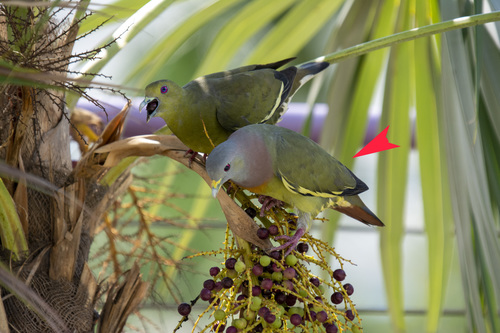
The Little Green-Pigeon and Pink-necked Green-Pigeon are both small, colorful pigeons often found in similar habitats. The most reliable field mark is the male Pink-necked Green-Pigeon's distinctive pink neck and chest, which the Little Green-Pigeon lacks. Both species can be seen in flocks, but their plumage and vocalizations offer further clues for identification.

Identification tips

  1. Look for the pink neck and chest in male Pink-necked Green-Pigeons. 2. Observe flock behavior; both species are often seen in groups. 3. Note the more uniform green plumage of Little Green-Pigeons. 4. Consider the habitat, as both are found in similar forested areas.

Size

Both species are similar in size, typical of small green-pigeons.

Plumage

Male Pink-necked Green-Pigeons have a pink neck and chest, while Little Green-Pigeons are more uniformly green. Females of both species are more similar, but the Pink-necked Green-Pigeon female has a slightly more colorful breast.

Behaviour

Both species forage in the midstory to canopy and are often seen in flocks. They are known to feed on figs and other fruits.

Habitat

Both species inhabit similar environments, often found in forests and wooded areas.

Voice

Vocalizations are not a primary distinguishing feature between these two species, as both have similar pigeon-like cooing calls.

Submit a better description

Use the same sections as the comparison. Your text is published immediately.

The Little Green-Pigeon and Pink-necked Green-Pigeon are both small, colorful pigeons often found in similar habitats. The most reliable field mark is the male Pink-necked Green-Pigeon's distinctive pink neck and chest, which the Little Green-Pigeon lacks. Both species can be seen in flocks, but their plumage and vocalizations offer further clues for identification.

  1. Look for the pink neck and chest in male Pink-necked Green-Pigeons. 2. Observe flock behavior; both species are often seen in groups. 3. Note the more uniform green plumage of Little Green-Pigeons. 4. Consider the habitat, as both are found in similar forested areas.

Both species are similar in size, typical of small green-pigeons.

Male Pink-necked Green-Pigeons have a pink neck and chest, while Little Green-Pigeons are more uniformly green. Females of both species are more similar, but the Pink-necked Green-Pigeon female has a slightly more colorful breast.

Both species forage in the midstory to canopy and are often seen in flocks. They are known to feed on figs and other fruits.

Both species inhabit similar environments, often found in forests and wooded areas.

Vocalizations are not a primary distinguishing feature between these two species, as both have similar pigeon-like cooing calls.

Discard your changes?

You have unsaved edits. If you leave now, those changes will be lost.

Little Green-Pigeon · Pink-necked Green-Pigeon · My Tricky Birds