
Little Gull vs Black-legged Kittiwake
Hydrocoloeus minutus versus Rissa tridactyla
Play a quiz with Little Gull and Black-legged Kittiwake
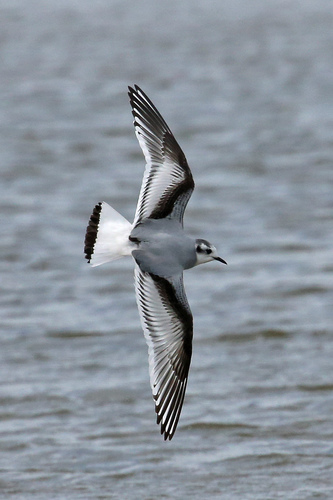 Little Gull
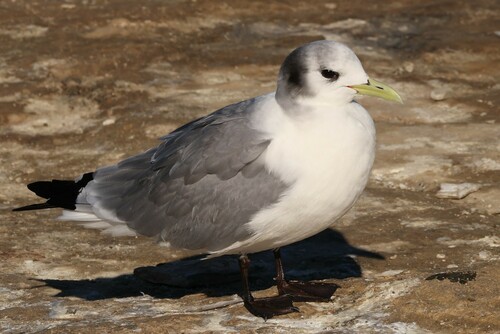 Black-legged Kittiwake
In short
The most reliable way to separate Little Gull from Black-legged Kittiwake, especially in flight, is by focusing on the upperwing pattern of juveniles and immatures: juvenile Little Gull shows a neat, narrow black 'W' across the upperwings, while juvenile Kittiwake has a broader, bolder black 'W' with more extensive black on the primaries and coverts. Adults are easier: Little Gull is much smaller, with a dark underwing and, in breeding plumage, a black hood; Kittiwake is larger, with a clean white head (except for a small smudge in winter), solid black wingtips, and a yellow bill. Structure and jizz are also distinct, with Little Gull appearing daintier and more tern-like. Both species can be seen in coastal contexts, but Little Gull is much less likely on open ocean cliffs. Size difference is extreme, with Kittiwake over four times heavier.
Identification tips
- Juvenile upperwing pattern: Juvenile Little Gull shows a narrow, neat black 'W' across the upperwings, with white underwings and tail; Kittiwake's 'W' is broader, with more black on the primaries and coverts, plus a black tail band and hind-neck collar. This is the single most useful mark for immatures in flight.
- Adult underwing: Adult Little Gull has a strikingly dark grey underwing, visible in all plumages and unique among gulls of this size; Kittiwake's underwing is pale.
- Adult head pattern: Breeding Little Gull has a full black hood (not just a cap); Kittiwake is always white-headed except for a faint grey smudge behind the eye and a grey hind-neck collar in winter.
- Bill color: Adult Little Gull has a dark red (breeding) or black (non-breeding) bill; Kittiwake has a yellow bill as an adult, greenish in second-year, and solid black only in juveniles.
- Leg color: Little Gull has bright red legs in breeding plumage, duller in non-breeding; Kittiwake has black legs (occasionally pinkish), never red.
- Size: Kittiwake is more than four times heavier and much larger in all dimensions; Little Gull is tiny and delicate by comparison. This is obvious in direct comparison or mixed flocks.
- Tail pattern: Juvenile Kittiwake has a black terminal band on the tail; Little Gull's tail is mostly white.
- Head and neck: Juvenile Kittiwake shows a black hind-neck collar; Little Gull does not.
- Flight style: Little Gull is buoyant and tern-like, often picking insects from the air or water; Kittiwake is more powerful and glides more, especially near cliffs or at sea.
- Habitat: Little Gull is more likely on inland lakes or sheltered coasts; Kittiwake is almost always marine, especially near cliffs or far offshore.
- Plumage progression: Kittiwake takes four years to reach full adult plumage, with black markings persisting on the wings and tail for several years; Little Gull matures faster, with second-year birds already resembling adults except for some black in the primaries.
- Bill structure: Little Gull has a fine, delicate bill; Kittiwake's is stouter and longer, especially in adults.
- Voice: Only Kittiwake gives the loud 'kittee-wa-aaake' call; Little Gull is much quieter.
- Perched posture: Little Gull appears compact and short-legged; Kittiwake stands taller and longer-winged, with a more upright stance.
- Contextual clues: In large, noisy seabird colonies or on open ocean, Kittiwake is expected; a lone small gull on an inland lake is more likely Little Gull.
Size
Little Gull is the smallest gull in the world, weighing about 98 g, with a length of 24–28 cm and wingspan of 62–69 cm. Black-legged Kittiwake is much larger, weighing 305–525 g (average ~418 g), measuring 37–41 cm long with a wingspan of 91–105 cm. In the field, Kittiwake looks robust and long-winged, while Little Gull is noticeably petite, delicate, and compact. Even at a distance or in mixed flocks, the size gap is striking and can be used as a quick check.
Plumage
Juvenile and first-winter birds are the main confusion point. Juvenile Little Gull shows a narrow, crisp black 'W' across the upperwings, with white underwings and a mostly white tail; the black is concentrated along the wing coverts and less extensive than in Kittiwake. Juvenile Kittiwake has a much broader black 'W' that extends across the length of the wings, with black on the primaries and a black terminal band on the tail, plus a black hind-neck collar. Both have solid black bills at this age. By first winter, Little Gull retains the upperwing pattern but the head and body become more adult-like; Kittiwake still shows black on the coverts and tail, but the bill turns greenish. Adult Little Gull in breeding plumage has a black hood, dark red bill, and bright red legs, with a pale grey back and white primaries contrasting with very dark grey underwing (diagnostic in flight). In non-breeding plumage, Little Gull loses the hood but keeps a black cap and ear spot. Adult Kittiwake is white-headed (with a faint grey smudge in winter), grey-backed, with solid black wingtips, black legs, and a yellow bill. Underwing of Kittiwake is pale, unlike the dark underwing of Little Gull. Only Little Gull ever shows a black hood; only Kittiwake has a yellow bill and solid black wingtips as an adult.
Behaviour
Little Gull is agile and buoyant, often feeding by picking insects from the water surface or in the air, with a tern-like, fluttery flight. Kittiwake is more robust, with a strong, gliding flight typical of oceanic gulls, often seen soaring along cliffs or over open water. Little Gull may be seen in flocks with other small gulls, while Kittiwake is usually in larger, noisier colonies or flocks, especially at sea.
Habitat
Little Gull breeds on inland freshwater lakes and marshes, and winters at sea or along coasts, sometimes mixing with other small gulls on sheltered waters. Black-legged Kittiwake is a classic seabird, breeding on sea cliffs and spending most of its life over open ocean, rarely venturing far inland. If seen on a freshwater lake, Little Gull is far more likely; on a sheer sea cliff or far offshore, Kittiwake dominates.
Voice
Kittiwake has a distinctive, shrill 'kittee-wa-aaake' call, often heard in noisy colonies. Little Gull is generally quieter and does not have a similarly loud or diagnostic call. Voice is rarely a primary field mark for separating these two, but the presence of the classic kittiwake call confirms that species.