Birdr

Little Penguin vs Fiordland Penguin

Eudyptula minor versus Eudyptes pachyrhynchus

Play a quiz with Little Penguin and Fiordland Penguin
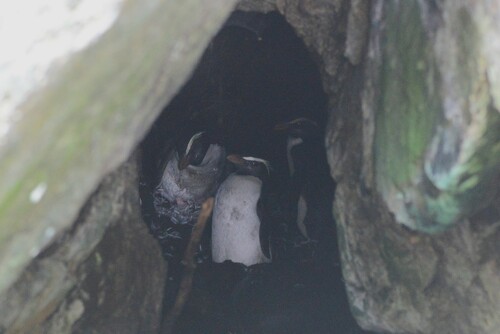
Little Penguin (Eudyptula minor) Little Penguin
Fiordland Penguin (Eudyptes pachyrhynchus) Fiordland Penguin

Media

Loading…

In short

The Little Penguin is best identified by its small size and uniform blue-grey upperparts, while the Fiordland Penguin is distinguished by its prominent yellow eyebrow stripe and larger size. These two species are not closely related, with the Little Penguin being the smallest penguin species and the Fiordland Penguin belonging to the crested penguins.

Identification tips

  1. Size: Little Penguins are much smaller. 2. Plumage: Look for the yellow eyebrow stripe on Fiordland Penguins. 3. Location: Consider the habitat; Little Penguins are more urban, while Fiordland Penguins are in remote, forested areas. 4. Group Behavior: Little Penguins are often seen in larger groups.

Size

The Little Penguin is notably smaller than the Fiordland Penguin.

Plumage

Little Penguins have uniform blue-grey upperparts and white underparts. In contrast, Fiordland Penguins feature a distinctive yellow eyebrow stripe extending from the bill to the back of the head, with black upperparts and white underparts.

Behaviour

Both species are primarily nocturnal on land, but the Little Penguin is more likely to be seen in large groups, especially during breeding season.

Habitat

Little Penguins are found along the southern coastlines of Australia and New Zealand, often near urban areas. Fiordland Penguins inhabit the rugged coasts and forests of New Zealand's South Island, particularly in remote areas.

Voice

Little Penguins are known for their loud braying calls, especially at night. Fiordland Penguins also vocalize, but their calls are less well-documented in field guides.

Submit a better description

Use the same sections as the comparison. Your text is published immediately.

The Little Penguin is best identified by its small size and uniform blue-grey upperparts, while the Fiordland Penguin is distinguished by its prominent yellow eyebrow stripe and larger size. These two species are not closely related, with the Little Penguin being the smallest penguin species and the Fiordland Penguin belonging to the crested penguins.

  1. Size: Little Penguins are much smaller. 2. Plumage: Look for the yellow eyebrow stripe on Fiordland Penguins. 3. Location: Consider the habitat; Little Penguins are more urban, while Fiordland Penguins are in remote, forested areas. 4. Group Behavior: Little Penguins are often seen in larger groups.

The Little Penguin is notably smaller than the Fiordland Penguin.

Little Penguins have uniform blue-grey upperparts and white underparts. In contrast, Fiordland Penguins feature a distinctive yellow eyebrow stripe extending from the bill to the back of the head, with black upperparts and white underparts.

Both species are primarily nocturnal on land, but the Little Penguin is more likely to be seen in large groups, especially during breeding season.

Little Penguins are found along the southern coastlines of Australia and New Zealand, often near urban areas. Fiordland Penguins inhabit the rugged coasts and forests of New Zealand's South Island, particularly in remote areas.

Little Penguins are known for their loud braying calls, especially at night. Fiordland Penguins also vocalize, but their calls are less well-documented in field guides.

Discard your changes?

You have unsaved edits. If you leave now, those changes will be lost.

Little Penguin · Fiordland Penguin · My Tricky Birds