Birdr

Little Swift vs White-rumped Swift

Apus affinis versus Apus caffer

Play a quiz with Little Swift and White-rumped Swift
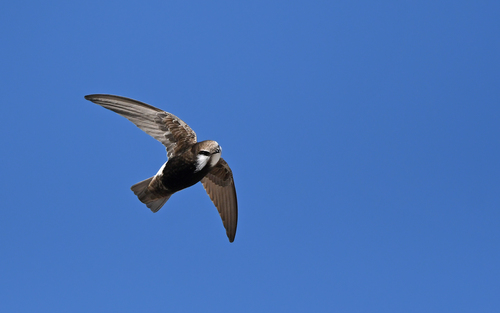
Little Swift (Apus affinis) Little Swift
White-rumped Swift (Apus caffer) White-rumped Swift

Media

Loading…

In short

The Little Swift and White-rumped Swift can be distinguished primarily by their tail shape and rump color. Little Swift has a square tail and a white rump patch, while White-rumped Swift has a deeply forked tail and a more extensive white rump. Both species are similar in size and flight style.

Identification tips

  1. Look for the tail shape: Little Swift has a square tail, while White-rumped Swift has a deeply forked tail. 2. Check the rump patch: Little Swift's white rump is less extensive compared to the more prominent white rump of the White-rumped Swift. 3. Observe in good light to ensure accurate color and shape assessment.

Size

Both species are similar in size, typical of small swifts, making size a less reliable distinguishing feature.

Plumage

Little Swift has a square tail and a white rump patch that is less extensive, while White-rumped Swift features a deeply forked tail and a more prominent white rump.

Behaviour

Both species exhibit similar swift-like flight patterns, characterized by rapid, agile movements. Behavior is not a reliable differentiator.

Habitat

Both species can be found in open areas, often near human settlements, but specific habitat preferences may overlap, making habitat a less reliable field mark.

Voice

Vocalizations are not distinct enough between the two species to serve as a reliable field mark.

Submit a better description

Use the same sections as the comparison. Your text is published immediately.

The Little Swift and White-rumped Swift can be distinguished primarily by their tail shape and rump color. Little Swift has a square tail and a white rump patch, while White-rumped Swift has a deeply forked tail and a more extensive white rump. Both species are similar in size and flight style.

  1. Look for the tail shape: Little Swift has a square tail, while White-rumped Swift has a deeply forked tail. 2. Check the rump patch: Little Swift's white rump is less extensive compared to the more prominent white rump of the White-rumped Swift. 3. Observe in good light to ensure accurate color and shape assessment.

Both species are similar in size, typical of small swifts, making size a less reliable distinguishing feature.

Little Swift has a square tail and a white rump patch that is less extensive, while White-rumped Swift features a deeply forked tail and a more prominent white rump.

Both species exhibit similar swift-like flight patterns, characterized by rapid, agile movements. Behavior is not a reliable differentiator.

Both species can be found in open areas, often near human settlements, but specific habitat preferences may overlap, making habitat a less reliable field mark.

Vocalizations are not distinct enough between the two species to serve as a reliable field mark.

Discard your changes?

You have unsaved edits. If you leave now, those changes will be lost.

Little Swift · White-rumped Swift · My Tricky Birds