
Little Tern vs Least Tern
Sternula albifrons versus Sternula antillarum
Play a quiz with Little Tern and Least Tern
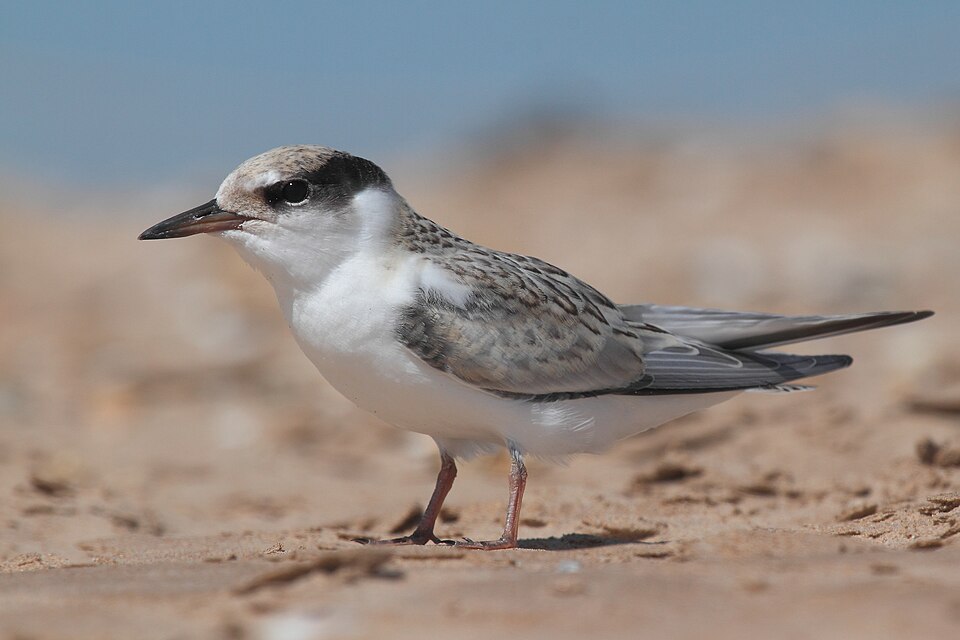 Little Tern
 Least Tern
In short
The most reliable field mark to separate Little Tern from Least Tern is the color of the rump and tail in all plumages: Little Tern has a white rump and tail, while Least Tern shows a gray rump and tail. Both species are very similar in size and structure, with yellow bills (black-tipped in breeding) and yellowish legs, but subtle differences in wing and tail coloration are key. In non-breeding (winter) plumage, both species show more extensive white on the forehead and darker bills, so careful attention to the rump and tail color is essential. Vocalizations differ, but are not always diagnostic in the field. Geographic context can help, as their breeding and wintering ranges barely overlap.
Identification tips
- Rump and tail color: The single most reliable mark—Little Tern has a white rump and tail, while Least Tern has a gray rump and tail. This works in all ages and seasons, including juveniles and non-breeding adults.
- Upperparts shade: Least Tern's upperparts are a fairly uniform pale gray; Little Tern is also pale gray, but this is not a strong separator.
- Bill color (breeding): Both have yellow bills with a black tip in breeding plumage. This is not a reliable separator between the two.
- Bill color (non-breeding): In winter, both species have mostly blackish bills, so this feature does not help separate them.
- Leg color: Both have yellowish legs, which become duller in winter. Not a useful separator.
- Forehead patch: Both species show a white forehead patch in breeding, which becomes more extensive in winter. The shape and size of the patch are similar in both.
- Cap and eye-stripe: Both have a black cap and a line through the eye to the bill base. In winter, the black cap is less sharply defined in both.
- Wing pattern: Both have pale gray wings with black markings on the outer primaries. No distinctive juvenile or immature wing pattern is mentioned to separate the two.
- Flight style: Least Tern is described as having fast, jerky wingbeats and a hunchbacked appearance with the bill pointing slightly downward. Little Tern's flight is similar but may appear less hunchbacked.
- Vocalizations: Least Tern's call is described as more squeaking compared to Little Tern, but this is subtle and not always diagnostic.
- Geographic context: If seen in the Americas, especially North America, it is almost certainly Least Tern. In Europe, Asia, Africa, or Australia, it is almost certainly Little Tern. Only extremely rare vagrants would reverse this.
- Habitat: Both species use similar open, sandy, or gravelly habitats near water, so habitat alone is not a separator unless combined with range.
- Size: Both are very small terns, with nearly identical measurements; size is not a field mark.
- Pitfalls: In non-breeding plumage, both species lose the bright bill and leg colors, and the white forehead expands, making them even more similar. Always check the rump and tail color.
- Age/season: No distinctive juvenile wing or upperpart pattern is described to separate the two, so focus on rump/tail color in all ages.
Size
Both species are very small terns, with Little Tern measuring 21–25 cm in length and Least Tern 22–24 cm, so size alone is not a reliable separator. Little Tern is slightly heavier (body mass ~57 g) compared to Least Tern (39–52 g), but this is not discernible in the field. Least Tern has a slightly longer wingspan (up to 50 cm vs. 47 cm for Little Tern), but this difference is subtle and not usually apparent in binocular views.
Plumage
- Juvenile/immature and non-breeding plumage: The most diagnostic feature is the color of the rump and tail: Little Tern has a white rump and tail, while Least Tern's rump and tail are gray. This holds true in all ages and seasons. Both species have pale gray upperparts and white underparts, but Least Tern's upperparts can appear slightly paler and more uniform.
- Breeding adult: Both show a black cap with a white forehead patch, yellow bill with a black tip, and yellowish legs. In breeding, these features are nearly identical, but the rump/tail color remains diagnostic.
- Non-breeding/winter adult: Both species develop a more extensive white forehead and the bill becomes mostly blackish, with duller legs. The black cap is less sharply defined. The rump/tail color difference remains the best mark.
- Wing pattern: Both have pale gray wings with black markings on the outer primaries, but there is no mention of distinctive juvenile wing markings (such as a black 'W' or trailing edge) that separate these two.
Behaviour
Both species hunt by hovering and plunge-diving for small fish in shallow water, often over estuaries, lagoons, or nearshore waters. Least Tern is noted for fast, jerky wingbeats and a hunchbacked flight silhouette with the bill angled slightly downward. Little Tern's flight style is similar, but the hunchbacked jizz is more often noted in Least Tern. Both species nest and roost on open ground with little cover.
Habitat
Little Tern breeds across Europe, Asia, north and west Africa, and eastern Australia, using coasts and inland waterways, and winters in subtropical/tropical oceans. Least Tern breeds in North America and locally in northern South America, wintering in Central America, the Caribbean, and northern South America. Their ranges do not overlap except as rare vagrants. Both species use similar habitats—open sandy or gravelly beaches, estuaries, and lagoons—but if you are in the Americas, Least Tern is expected; in the Old World, Little Tern is the default.
Voice
Least Tern has a distinctive, more squeaking call compared to Little Tern. However, calls are not always easily separated in the field, and both species can sound similar to the untrained ear. Vocalization is a supporting, not primary, field mark.