
Long-billed Curlew vs Eurasian Curlew
Numenius americanus versus Numenius arquata
Play a quiz with Long-billed Curlew and Eurasian Curlew
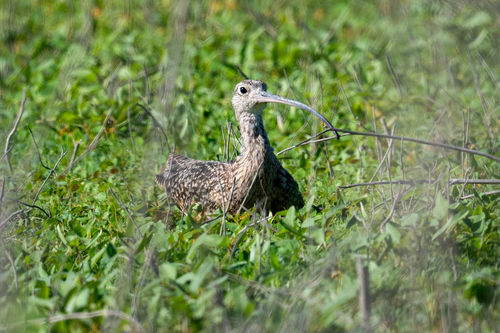 Long-billed Curlew
 Eurasian Curlew
In short
The most reliable field mark between Long-billed Curlew and Eurasian Curlew is the bill: Long-billed Curlew has a much longer, more dramatically downcurved bill, especially in females, while Eurasian Curlew's bill is long but generally shorter and less exaggerated. Both are large, brownish shorebirds with similar proportions, but Long-billed Curlew shows warmer cinnamon tones below and on the neck, contrasting with the greyer, more uniformly brown Eurasian Curlew. In flight or at rest, structural differences and subtle plumage cues can help, but bill length and underpart color are your best quick checks. Both species can be confusing at a distance or in poor light, so careful attention to these points is key.
Identification tips
- Bill length and shape: Long-billed Curlew's bill is extremely long (up to 21.9 cm), thin, and smoothly downcurved, often looking sickle-like, especially on females. Eurasian Curlew's bill is long but noticeably shorter and less exaggerated, with a more gradual curve. This is the single best field mark at all ages and seasons.
- Underpart color: Long-billed Curlew shows a warm, light cinnamon wash on the neck and underparts, visible in all plumages. Eurasian Curlew is more greyish or whitish below, lacking any rufous or cinnamon tones. Use this in good light or at close range.
- Overall tone: Long-billed Curlew appears warmer and buffier, especially on the neck and face. Eurasian Curlew is colder, more uniformly grey-brown above and below.
- Crown and head pattern: Both have streaked crowns, but this is not a strong separator. Focus on overall color and bill.
- Leg color: Eurasian Curlew has greyish-blue legs, which can be seen when perched or in flight. Long-billed Curlew's leg color is not specified but is not noted as diagnostic.
- Back color in flight: Eurasian Curlew has a white back, which may be visible in flight or when preening. Long-billed Curlew lacks this feature.
- Sex differences: Female Long-billed Curlews have the longest bills, but both sexes show the key differences from Eurasian Curlew. Eurasian Curlew sexes are similar, and bill length is not reliably sexed unless in a pair.
- Size and structure: Eurasian Curlew is slightly heavier and bulkier, with a broader wingspan, but this is subtle and not reliable unless birds are side by side. Long-billed Curlew may look longer and more stretched due to its bill and neck.
- Flight jizz: Both species fly with steady, strong wingbeats, but Long-billed Curlew may look more front-heavy and elongated due to its bill. Eurasian Curlew is more compact.
- Habitat context: In North America, assume Long-billed Curlew unless there is strong evidence for a vagrant Eurasian Curlew. In Eurasia, Eurasian Curlew is default. Habitat (grassland vs. marsh/mudflat) can help but is not definitive.
- Vocalizations: If you hear a loud, bubbling 'curloo-oo', it is Eurasian Curlew. Long-billed Curlew's calls are not described here, so use voice only if the classic curlew call is heard.
- Age/season: No distinctive juvenile or immature upperwing patterns are described for either species, so age is not a strong separator in the field.
- Pitfalls: At long range or in poor light, bill length can be hard to judge, and color tones can be misleading. Always try for a direct comparison or multiple field marks.
- Flock composition: Both species can form single-species flocks; mixed flocks are extremely rare except in vagrancy situations.
- Geographic range: Use range as a strong filter—Long-billed Curlew in North America, Eurasian Curlew in Eurasia. Out-of-range records require multiple confirming field marks.
Size
Eurasian Curlew averages slightly heavier (805.5 g vs 699.35 g) and has a broader wingspan (up to 106 cm vs 90 cm), but both are among the largest shorebirds in their respective ranges and overlap considerably in size. Length is similar, with Long-billed Curlew sometimes appearing longer due to its bill. In the field, size alone is rarely diagnostic unless birds are side by side, but Eurasian Curlew may look bulkier and more robust, while Long-billed Curlew often appears lankier, accentuated by its extremely long bill and neck.
Plumage
No distinctive juvenile or immature upperwing patterns are described for either species that would allow a quick separation in flight. Both species are overall brownish above with streaked crowns and pale underparts. Long-billed Curlew stands out with a light cinnamon wash on the neck and underparts, which is especially noticeable in good light and at close range, while Eurasian Curlew is more grey-brown and lacks any warm or rufous tones below. Eurasian Curlew has a white back and greyish-blue legs, which can sometimes be seen in flight or when perched. Both have streaked crowns, but the overall impression is warmer and more buffy in Long-billed Curlew, colder and more uniform in Eurasian Curlew. Sexes are similar in both, though female Long-billed Curlews have the longest bills; in Eurasian Curlew, bill length also varies but is less extreme and not reliably sexed in the field.
Behaviour
Both species forage by probing in soft ground, often in open grasslands or mudflats. Long-billed Curlew is known for elaborate courtship displays with looping flights, but this is rarely observed outside the breeding season. In flight, both show steady, strong wingbeats with long necks and legs trailing. Long-billed Curlew may appear more stretched and 'front-heavy' due to its bill. Eurasian Curlew can look bulkier and more compact, especially when feeding. Social behavior is similar, with both forming flocks outside the breeding season.
Habitat
Long-billed Curlew breeds in central and western North American grasslands and winters along coasts and southern lowlands. Eurasian Curlew breeds across temperate Europe and Asia, favoring meadows, moorland, and marshes, and winters along coasts, estuaries, and mudflats. In North America, Eurasian Curlew is extremely rare and would be a vagrant; in Eurasia, Long-billed Curlew is not expected. Habitat overlap is possible on migration or wintering grounds, but context usually helps: Long-billed Curlew is the default in North American prairies and western coasts, Eurasian Curlew in European and Asian wetlands.
Voice
Eurasian Curlew gives a loud, bubbling 'curloo-oo' call, which is the origin of its name. Long-billed Curlew's calls are not described in the provided notes, so vocalization is not a reliable separator here unless the Eurasian Curlew's distinctive call is heard.