Birdr

Long-billed Dowitcher vs Wilson's Phalarope

Limnodromus scolopaceus versus Phalaropus tricolor

Play a quiz with Long-billed Dowitcher and Wilson's Phalarope
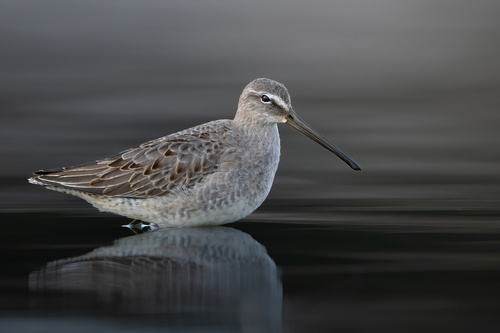
Long-billed Dowitcher (Limnodromus scolopaceus) Long-billed Dowitcher
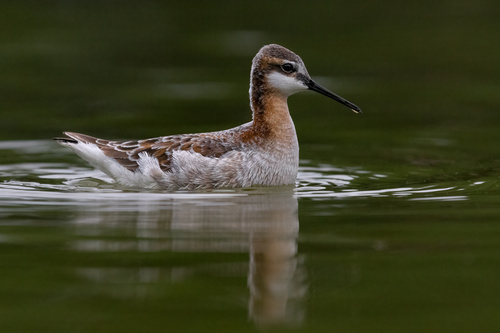
Wilson's Phalarope (Phalaropus tricolor) Wilson's Phalarope

Media

Loading…

In short

The Long-billed Dowitcher and Wilson's Phalarope are both medium-sized shorebirds, but they differ in structure and behavior. The Long-billed Dowitcher has a notably long, sturdy bill and a distinctive 'sewing machine' feeding motion, while Wilson's Phalarope has a thinner, needle-like bill and is often seen swimming in circles.

Identification tips

Size

Both species are medium-sized, but Wilson's Phalarope is slightly smaller (22–24 cm).

Plumage

Long-billed Dowitchers in breeding plumage have a reddish-brown underpart, while Wilson's Phalarope females in breeding plumage have a pale blue-gray forehead and crown with a black streak down the neck. In nonbreeding plumage, Wilson's Phalarope is pale gray above with a white supercilium.

Behaviour

Long-billed Dowitchers feed with a 'sewing machine' motion in mudflats, while Wilson's Phalaropes often swim in circles to stir up food.

Habitat

Long-billed Dowitchers are found in small pools and salt-marsh vegetation, whereas Wilson's Phalaropes prefer open water bodies where they can swim.

Voice

Long-billed Dowitchers have a distinctive call when flying and feeding, while Wilson's Phalarope's vocalizations are less distinctive and not emphasized in field identification.

Submit a better description

Use the same sections as the comparison. Your text is published immediately.

The Long-billed Dowitcher and Wilson's Phalarope are both medium-sized shorebirds, but they differ in structure and behavior. The Long-billed Dowitcher has a notably long, sturdy bill and a distinctive 'sewing machine' feeding motion, while Wilson's Phalarope has a thinner, needle-like bill and is often seen swimming in circles.

  • Bill shape: Long-billed Dowitcher has a long, sturdy bill; Wilson's Phalarope has a thin, needle-like bill.
  • Feeding behavior: Look for the 'sewing machine' motion of the Dowitcher versus the swimming behavior of the Phalarope.
  • Plumage: In breeding season, note the reddish underparts of the Dowitcher and the black streak on the neck of the female Phalarope.
  • Habitat: Dowitchers are more likely in mudflats, Phalaropes in open water.

Both species are medium-sized, but Wilson's Phalarope is slightly smaller (22–24 cm).

Long-billed Dowitchers in breeding plumage have a reddish-brown underpart, while Wilson's Phalarope females in breeding plumage have a pale blue-gray forehead and crown with a black streak down the neck. In nonbreeding plumage, Wilson's Phalarope is pale gray above with a white supercilium.

Long-billed Dowitchers feed with a 'sewing machine' motion in mudflats, while Wilson's Phalaropes often swim in circles to stir up food.

Long-billed Dowitchers are found in small pools and salt-marsh vegetation, whereas Wilson's Phalaropes prefer open water bodies where they can swim.

Long-billed Dowitchers have a distinctive call when flying and feeding, while Wilson's Phalarope's vocalizations are less distinctive and not emphasized in field identification.

Discard your changes?

You have unsaved edits. If you leave now, those changes will be lost.

Long-billed Dowitcher · Wilson's Phalarope · My Tricky Birds