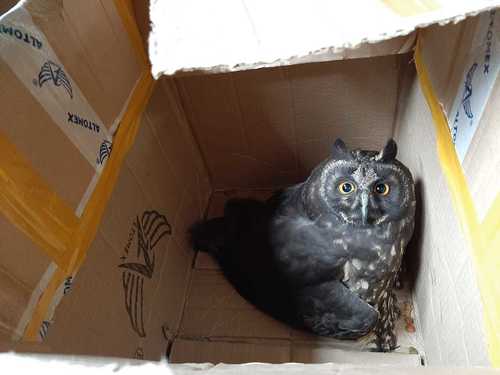
Long-eared Owl vs Stygian Owl
Asio otus versus Asio stygius
Play a quiz with Long-eared Owl and Stygian Owl
Stygian Owl
In short
The Long-eared Owl and Stygian Owl can be distinguished by their plumage and habitat preferences. Long-eared Owls have a more uniform brownish appearance with less prominent streaking, while Stygian Owls show dense dark streaking on the underparts and a smaller, darker head. Both species have prominent ear tufts, but their habitat preferences differ, with Long-eared Owls favoring dense vegetation for roosting and Stygian Owls found in open woodlands.
Identification tips
1. Look for dense dark streaking on the underparts for Stygian Owls. 2. Note the habitat: dense vegetation suggests Long-eared Owl, while open woodlands suggest Stygian Owl. 3. Observe the head size and color: Stygian Owl has a smaller, darker head. 4. Both have prominent ear tufts, so rely more on plumage and habitat.
Size
Both species are similar in size, but the Stygian Owl may appear slightly more attenuated due to its smaller head.
Plumage
Long-eared Owls have a more uniform brownish plumage with less streaking, while Stygian Owls exhibit dense dark streaking on the underparts and a darker head.
Behaviour
Long-eared Owls often roost communally, especially in the nonbreeding season, while Stygian Owls are less known for this behavior.
Habitat
Long-eared Owls prefer dense vegetation for roosting and open habitats for hunting, whereas Stygian Owls are found in relatively open woodlands, including urban parks.
Voice
Vocalizations are not well-documented for field differentiation; consult local guides for specific calls.