Long-eared Owl vs Tengmalm's Owl
Asio otus versus Aegolius funereus
Play a quiz with Long-eared Owl and Tengmalm's Owl
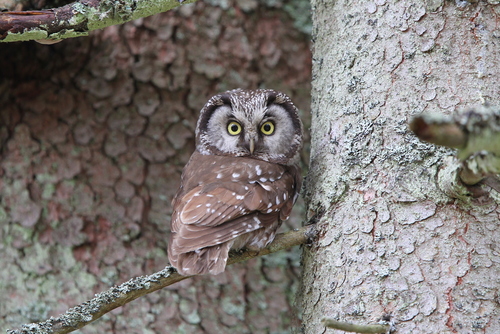
Tengmalm's Owl
In short
The Long-eared Owl and Tengmalm's Owl can be distinguished by their ear tufts and facial disc patterns. Long-eared Owls have prominent ear tufts and a more elongated body, while Tengmalm's Owls have a rounded head with no ear tufts and a distinct facial disc.
Identification tips
- Look for ear tufts: Long-eared Owls have them, Tengmalm's Owls do not. 2. Check the facial disc: Tengmalm's Owls have a distinct white disc with a dark border. 3. Observe size and shape: Long-eared Owls are larger and more elongated. 4. Listen for calls: Long-eared Owls hoot, Tengmalm's Owls whistle.
Size
Long-eared Owls are larger and more slender compared to the smaller, more compact Tengmalm's Owls.
Plumage
Long-eared Owls have a mottled brown plumage with a pale face and dark vertical streaks. Tengmalm's Owls have a more uniform brown plumage with a distinctive white facial disc and dark border.
Behaviour
Long-eared Owls often roost communally and hunt in open areas, while Tengmalm's Owls are more solitary and prefer dense forests for hunting.
Habitat
Long-eared Owls are found in open habitats with dense vegetation for roosting, while Tengmalm's Owls inhabit dense coniferous forests.
Voice
Long-eared Owls have a low, repetitive hoot, whereas Tengmalm's Owls produce a series of high-pitched, whistled notes.