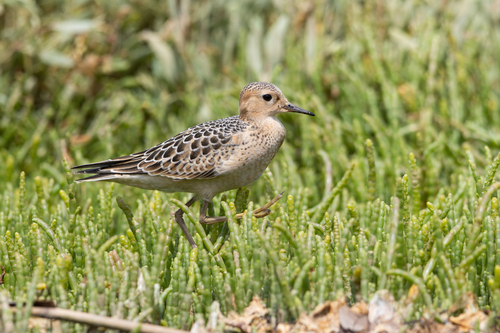
Long-toed Stint vs Buff-breasted Sandpiper
Calidris subminuta versus Calidris subruficollis
Play a quiz with Long-toed Stint and Buff-breasted Sandpiper
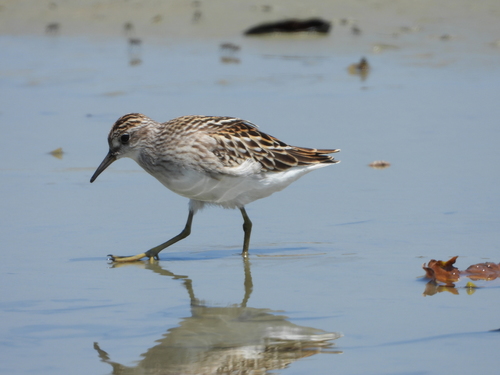
Long-toed Stint
Buff-breasted Sandpiper
In short
The Long-toed Stint and Buff-breasted Sandpiper can be distinguished primarily by their structure and plumage. The Long-toed Stint is smaller, with notably long toes that project beyond the tail in flight, while the Buff-breasted Sandpiper is larger with a more uniform buff coloration.
Identification tips
- Check toe length: Long-toed Stint's toes project beyond the tail in flight.
- Observe plumage: Look for the rufous crown and streaked breast in Long-toed Stint.
- Consider habitat: Long-toed Stint is more likely in wetland areas, Buff-breasted Sandpiper in grassy fields.
- Listen for calls: Long-toed Stint has distinctive trilling calls, Buff-breasted Sandpiper is quieter.
Size
The Long-toed Stint is smaller (13–16 cm) compared to the Buff-breasted Sandpiper, which is larger and more robust.
Plumage
The Long-toed Stint has a rufous crown and ear-coverts with dark streaks, a prominent whitish supercilium, and finely streaked neck and breast. In contrast, the Buff-breasted Sandpiper displays a more uniform buff coloration across its body without the distinct streaking.
Behaviour
Both species exhibit similar foraging behaviors typical of sandpipers, but the Long-toed Stint's long toes are adapted for walking on soft mud.
Habitat
The Long-toed Stint is often found in wetland areas with muddy edges, while the Buff-breasted Sandpiper prefers dry, grassy habitats during migration.
Voice
The Long-toed Stint has a variety of calls, including a trilling 'chee' or 'prrrt', and a soft rolling 'kurrip'. The Buff-breasted Sandpiper is generally quieter, with fewer vocalizations noted.