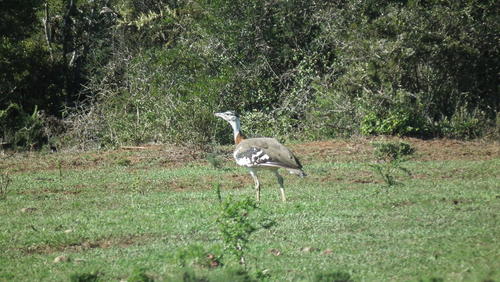
Ludwig's Bustard vs Denham's Bustard
Neotis ludwigii versus Neotis denhami
Play a quiz with Ludwig's Bustard and Denham's Bustard
Ludwig's Bustard
Denham's Bustard
In short
Ludwig's Bustard and Denham's Bustard are large, ground-dwelling birds that can be distinguished by their size and plumage patterns. Ludwig's Bustard is generally smaller and has a more uniform coloration, while Denham's Bustard is larger with distinctive black and white wing patterns. Observing these differences in open habitats can aid in identification.
Identification tips
- Size and Structure: Look for the larger size and more robust build of Denham's Bustard. 2. Plumage in Flight: Note the black and white wing patterns of Denham's Bustard, which are absent in Ludwig's Bustard. 3. Habitat Context: Consider the habitat; Denham's Bustard is more likely in grasslands, while Ludwig's Bustard favors arid regions. 4. Behavior: Observe any display behaviors during the breeding season, though these are not definitive. 5. Seasonal Variations: Be aware of potential seasonal movements that might bring these species into atypical habitats.
Size
Denham's Bustard is larger than Ludwig's Bustard, appearing more robust and heavier.
Plumage
Ludwig's Bustard has a more uniform brownish-grey plumage, whereas Denham's Bustard features striking black and white patterns on its wings, especially noticeable in flight.
Behaviour
Both species are ground-dwelling and often seen walking slowly in open areas. They may be observed displaying during the breeding season, but such behaviors are not distinct enough for reliable identification.
Habitat
Ludwig's Bustard is typically found in arid and semi-arid regions, while Denham's Bustard prefers grasslands and savannas. Overlapping habitats can occur, making habitat alone an unreliable differentiator.
Voice
Vocalizations are not well-documented for either species, and they are generally silent, making calls an unreliable field mark.