Birdr

MacGillivray's Warbler vs Mourning Warbler

Geothlypis tolmiei versus Geothlypis philadelphia

Play a quiz with MacGillivray's Warbler and Mourning Warbler
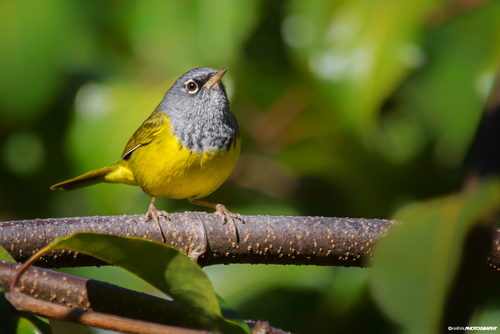
MacGillivray's Warbler (Geothlypis tolmiei) MacGillivray's Warbler
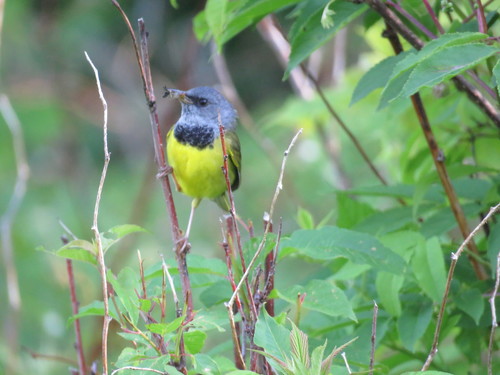
Mourning Warbler (Geothlypis philadelphia) Mourning Warbler

Media

Loading…

In short

MacGillivray's Warbler and Mourning Warbler are closely related and can be challenging to distinguish, especially in overlapping ranges. The most reliable field mark is the presence of a distinct white eye arc on MacGillivray's Warbler, absent in Mourning Warbler. Both species share similar habitats and behaviors, but their songs differ.

Identification tips

  1. Look for the white eye arc on MacGillivray's Warbler. 2. Note the uniform gray hood of the Mourning Warbler. 3. Listen for song differences: MacGillivray's has a more complex song. 4. Consider habitat: both prefer dense, shrubby areas. 5. Be aware of potential hybrid zones where identification may be challenging.

Size

Both species are similar in size, typical of small warblers.

Plumage

MacGillivray's Warbler has a distinct white eye arc, which is a key differentiator from the Mourning Warbler, which lacks this feature. Both species have a similar overall color palette, with olive upperparts and yellow underparts, but the Mourning Warbler often shows a more uniform gray hood.

Behaviour

Both species are secretive and often forage low in dense vegetation, making them difficult to observe.

Habitat

Both species prefer dense thickets and shrubby areas, often near water. They can be found in similar habitats during migration and breeding.

Voice

The songs of both species are distinct, with MacGillivray's Warbler having a more complex and varied song compared to the simpler, more repetitive song of the Mourning Warbler.

Submit a better description

Use the same sections as the comparison. Your text is published immediately.

MacGillivray's Warbler and Mourning Warbler are closely related and can be challenging to distinguish, especially in overlapping ranges. The most reliable field mark is the presence of a distinct white eye arc on MacGillivray's Warbler, absent in Mourning Warbler. Both species share similar habitats and behaviors, but their songs differ.

  1. Look for the white eye arc on MacGillivray's Warbler. 2. Note the uniform gray hood of the Mourning Warbler. 3. Listen for song differences: MacGillivray's has a more complex song. 4. Consider habitat: both prefer dense, shrubby areas. 5. Be aware of potential hybrid zones where identification may be challenging.

Both species are similar in size, typical of small warblers.

MacGillivray's Warbler has a distinct white eye arc, which is a key differentiator from the Mourning Warbler, which lacks this feature. Both species have a similar overall color palette, with olive upperparts and yellow underparts, but the Mourning Warbler often shows a more uniform gray hood.

Both species are secretive and often forage low in dense vegetation, making them difficult to observe.

Both species prefer dense thickets and shrubby areas, often near water. They can be found in similar habitats during migration and breeding.

The songs of both species are distinct, with MacGillivray's Warbler having a more complex and varied song compared to the simpler, more repetitive song of the Mourning Warbler.

Discard your changes?

You have unsaved edits. If you leave now, those changes will be lost.

MacGillivray's Warbler · Mourning Warbler · My Tricky Birds