Birdr

Magnolia Warbler vs Bay-breasted Warbler

Setophaga magnolia versus Setophaga castanea

Play a quiz with Magnolia Warbler and Bay-breasted Warbler
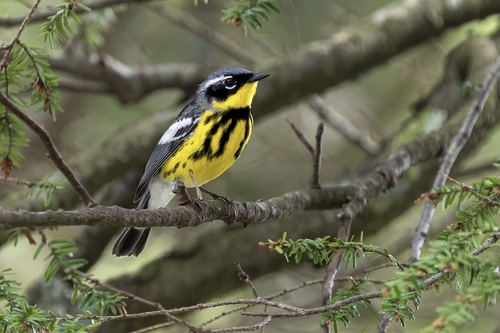
Magnolia Warbler (Setophaga magnolia) Magnolia Warbler
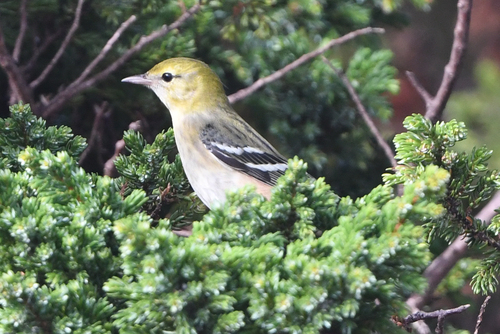
Bay-breasted Warbler (Setophaga castanea) Bay-breasted Warbler

Media

Loading…

In short

Magnolia Warblers and Bay-breasted Warblers can be distinguished by plumage and habitat preferences. Magnolia Warblers have a distinctive black mask and white wing bars, while Bay-breasted Warblers in breeding plumage show a rich chestnut color on the flanks and crown. Habitat preferences also differ, with Magnolia Warblers favoring dense deciduous forests and Bay-breasted Warblers preferring boreal coniferous forests.

Identification tips

  1. Plumage: Look for the black mask and white wing bars on Magnolia Warblers; check for chestnut flanks and crown on Bay-breasted Warblers in breeding plumage. 2. Habitat: Note the forest type—deciduous for Magnolia, coniferous for Bay-breasted. 3. Season: Be aware that nonbreeding Bay-breasted Warblers can resemble Blackpoll Warblers, complicating identification outside the breeding season.

Size

Both species are small warblers, but they are similar in size, making size an unreliable field mark.

Plumage

Magnolia Warblers have a striking black mask and a white wing bar, with a yellow underside streaked with black. Bay-breasted Warblers in breeding plumage display chestnut on the flanks and crown, while nonbreeding and female Bay-breasted Warblers can appear more muted and are often confused with Blackpoll Warblers.

Behaviour

Both species are active foragers, but there are no significant behavioral differences noted that aid in field identification.

Habitat

Magnolia Warblers are typically found in dense deciduous forests, while Bay-breasted Warblers prefer boreal coniferous forests, particularly during spruce budworm outbreaks.

Voice

Vocalizations are not a primary distinguishing feature between these two species, as they are not notably different.

Submit a better description

Use the same sections as the comparison. Your text is published immediately.

Magnolia Warblers and Bay-breasted Warblers can be distinguished by plumage and habitat preferences. Magnolia Warblers have a distinctive black mask and white wing bars, while Bay-breasted Warblers in breeding plumage show a rich chestnut color on the flanks and crown. Habitat preferences also differ, with Magnolia Warblers favoring dense deciduous forests and Bay-breasted Warblers preferring boreal coniferous forests.

  1. Plumage: Look for the black mask and white wing bars on Magnolia Warblers; check for chestnut flanks and crown on Bay-breasted Warblers in breeding plumage. 2. Habitat: Note the forest type—deciduous for Magnolia, coniferous for Bay-breasted. 3. Season: Be aware that nonbreeding Bay-breasted Warblers can resemble Blackpoll Warblers, complicating identification outside the breeding season.

Both species are small warblers, but they are similar in size, making size an unreliable field mark.

Magnolia Warblers have a striking black mask and a white wing bar, with a yellow underside streaked with black. Bay-breasted Warblers in breeding plumage display chestnut on the flanks and crown, while nonbreeding and female Bay-breasted Warblers can appear more muted and are often confused with Blackpoll Warblers.

Both species are active foragers, but there are no significant behavioral differences noted that aid in field identification.

Magnolia Warblers are typically found in dense deciduous forests, while Bay-breasted Warblers prefer boreal coniferous forests, particularly during spruce budworm outbreaks.

Vocalizations are not a primary distinguishing feature between these two species, as they are not notably different.

Discard your changes?

You have unsaved edits. If you leave now, those changes will be lost.

Magnolia Warbler · Bay-breasted Warbler · My Tricky Birds