Birdr

Malaysian Pied-Fantail vs Ashy Drongo

Rhipidura javanica versus Dicrurus leucophaeus

Play a quiz with Malaysian Pied-Fantail and Ashy Drongo
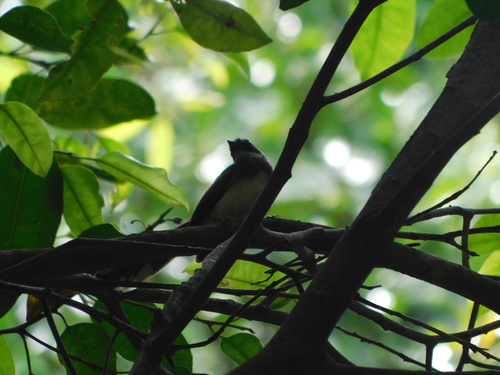
Malaysian Pied-Fantail (Rhipidura javanica) Malaysian Pied-Fantail
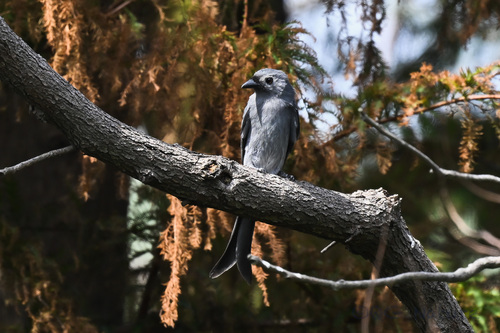
Ashy Drongo (Dicrurus leucophaeus) Ashy Drongo

Media

Loading…

In short

The Malaysian Pied-Fantail and Ashy Drongo can be distinguished by their tail shape and plumage color. The fantail has a distinct fan-shaped tail and contrasting black and white plumage, while the drongo has a more uniform dark gray to blackish coloration and a forked tail.

Identification tips

  1. Look for the tail shape: fan-shaped in the fantail, forked in the drongo. 2. Note the plumage contrast: black and white in the fantail, uniform dark in the drongo. 3. Observe behavior: fantails are more active and often fan their tails, drongos perch more openly. 4. Listen for vocal differences: musical in the fantail, harsh in the drongo.

Size

The Ashy Drongo is generally larger than the Malaysian Pied-Fantail.

Plumage

The Malaysian Pied-Fantail shows a striking contrast with its black head, white underparts, and black and white tail. In contrast, the Ashy Drongo is more uniformly dark gray to blackish, lacking the strong contrast seen in the fantail.

Behaviour

The Malaysian Pied-Fantail often fans its tail and is more active in the undergrowth, while the Ashy Drongo is more likely to be seen perched openly, often on higher branches.

Habitat

Both species can be found in similar habitats such as forests and gardens, but the Malaysian Pied-Fantail prefers denser undergrowth, whereas the Ashy Drongo is more adaptable and can be found in a wider range of open and semi-open areas.

Voice

The Malaysian Pied-Fantail has a more varied and musical song, while the Ashy Drongo's calls are harsher and more repetitive.

Submit a better description

Use the same sections as the comparison. Your text is published immediately.

The Malaysian Pied-Fantail and Ashy Drongo can be distinguished by their tail shape and plumage color. The fantail has a distinct fan-shaped tail and contrasting black and white plumage, while the drongo has a more uniform dark gray to blackish coloration and a forked tail.

  1. Look for the tail shape: fan-shaped in the fantail, forked in the drongo. 2. Note the plumage contrast: black and white in the fantail, uniform dark in the drongo. 3. Observe behavior: fantails are more active and often fan their tails, drongos perch more openly. 4. Listen for vocal differences: musical in the fantail, harsh in the drongo.

The Ashy Drongo is generally larger than the Malaysian Pied-Fantail.

The Malaysian Pied-Fantail shows a striking contrast with its black head, white underparts, and black and white tail. In contrast, the Ashy Drongo is more uniformly dark gray to blackish, lacking the strong contrast seen in the fantail.

The Malaysian Pied-Fantail often fans its tail and is more active in the undergrowth, while the Ashy Drongo is more likely to be seen perched openly, often on higher branches.

Both species can be found in similar habitats such as forests and gardens, but the Malaysian Pied-Fantail prefers denser undergrowth, whereas the Ashy Drongo is more adaptable and can be found in a wider range of open and semi-open areas.

The Malaysian Pied-Fantail has a more varied and musical song, while the Ashy Drongo's calls are harsher and more repetitive.

Discard your changes?

You have unsaved edits. If you leave now, those changes will be lost.

Malaysian Pied-Fantail · Ashy Drongo · My Tricky Birds