Birdr

Malaysian Pied-Fantail vs White-browed Fantail

Rhipidura javanica versus Rhipidura aureola

Play a quiz with Malaysian Pied-Fantail and White-browed Fantail
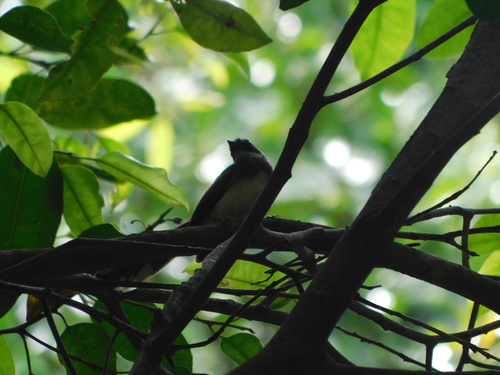
Malaysian Pied-Fantail (Rhipidura javanica) Malaysian Pied-Fantail
White-browed Fantail (Rhipidura aureola) White-browed Fantail

Media

Loading…

In short

The Malaysian Pied-Fantail and White-browed Fantail are similar in size and structure, but can be distinguished by their plumage and vocalizations. The Malaysian Pied-Fantail has a more uniform dark plumage with a distinct white throat, while the White-browed Fantail features a prominent white supercilium and contrasting dark crown.

Identification tips

  1. Look for the presence or absence of a white supercilium: White-browed Fantail has it, Malaysian Pied-Fantail does not. 2. Note the throat color: Malaysian Pied-Fantail has a white throat, contrasting with its darker body. 3. Listen for vocalizations: Malaysian Pied-Fantail has a more complex song. 4. Consider habitat: Malaysian Pied-Fantail in mangroves, White-browed Fantail in open woodlands.

Size

Both species are similar in size, typical of fantails, with no significant differences in overall dimensions.

Plumage

The Malaysian Pied-Fantail has a dark, almost blackish upper body with a clear white throat and belly, lacking the white supercilium. In contrast, the White-browed Fantail has a striking white supercilium and a darker crown, with a more contrasting appearance between the head and body.

Behaviour

Both species exhibit typical fantail behavior, such as frequent tail fanning and agile flight. There are no significant behavioral differences noted in the field.

Habitat

The Malaysian Pied-Fantail is often found in mangroves and lowland forests, while the White-browed Fantail prefers more open woodlands and scrub areas. Overlapping habitats can occur, but these preferences can guide identification.

Voice

The Malaysian Pied-Fantail has a more varied and complex song compared to the simpler, repetitive calls of the White-browed Fantail. Vocalizations can be a useful differentiator if observed.

Submit a better description

Use the same sections as the comparison. Your text is published immediately.

The Malaysian Pied-Fantail and White-browed Fantail are similar in size and structure, but can be distinguished by their plumage and vocalizations. The Malaysian Pied-Fantail has a more uniform dark plumage with a distinct white throat, while the White-browed Fantail features a prominent white supercilium and contrasting dark crown.

  1. Look for the presence or absence of a white supercilium: White-browed Fantail has it, Malaysian Pied-Fantail does not. 2. Note the throat color: Malaysian Pied-Fantail has a white throat, contrasting with its darker body. 3. Listen for vocalizations: Malaysian Pied-Fantail has a more complex song. 4. Consider habitat: Malaysian Pied-Fantail in mangroves, White-browed Fantail in open woodlands.

Both species are similar in size, typical of fantails, with no significant differences in overall dimensions.

The Malaysian Pied-Fantail has a dark, almost blackish upper body with a clear white throat and belly, lacking the white supercilium. In contrast, the White-browed Fantail has a striking white supercilium and a darker crown, with a more contrasting appearance between the head and body.

Both species exhibit typical fantail behavior, such as frequent tail fanning and agile flight. There are no significant behavioral differences noted in the field.

The Malaysian Pied-Fantail is often found in mangroves and lowland forests, while the White-browed Fantail prefers more open woodlands and scrub areas. Overlapping habitats can occur, but these preferences can guide identification.

The Malaysian Pied-Fantail has a more varied and complex song compared to the simpler, repetitive calls of the White-browed Fantail. Vocalizations can be a useful differentiator if observed.

Discard your changes?

You have unsaved edits. If you leave now, those changes will be lost.

Malaysian Pied-Fantail · White-browed Fantail · My Tricky Birds