Birdr

Mallard vs Mexican Duck

Anas platyrhynchos versus Anas diazi

Play a quiz with Mallard and Mexican Duck
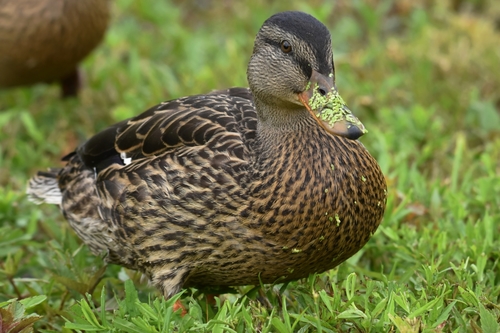
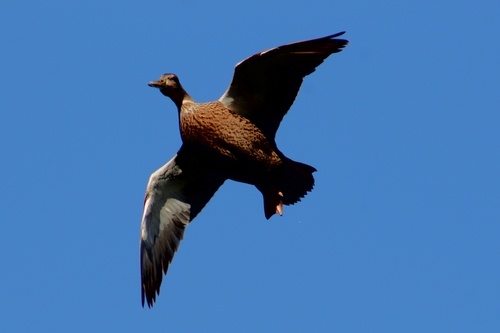
Mallard (Anas platyrhynchos) Mallard
Mexican Duck (Anas diazi) Mexican Duck

Media

Loading…

In short

Mallards and Mexican Ducks are closely related, making them challenging to distinguish in the field. The most reliable field mark is the male Mallard's distinctive green head, which the Mexican Duck lacks. Females and eclipse males are more similar, requiring careful attention to subtle differences in plumage and structure.

Identification tips

Size

Both species are similar in size, with no significant differences in overall structure.

Plumage

Male Mallards have a bright green head, while Mexican Ducks have a more uniform brownish body without the green head. Female Mallards and Mexican Ducks are more similar, but Mexican Ducks generally have a more uniform brown plumage with less contrast between the body and head.

Behaviour

Both species exhibit similar behaviors, often seen dabbling in shallow water and foraging on land.

Habitat

Mallards are widespread across North America, found in a variety of wetland habitats, including urban areas. Mexican Ducks are more localized, primarily found in the southwestern U.S. and northern Mexico, often associated with permanent rivers and large lakes.

Voice

Vocalizations are similar, with both species producing quacking sounds. Distinguishing them by voice alone is challenging.

Submit a better description

Use the same sections as the comparison. Your text is published immediately.

Mallards and Mexican Ducks are closely related, making them challenging to distinguish in the field. The most reliable field mark is the male Mallard's distinctive green head, which the Mexican Duck lacks. Females and eclipse males are more similar, requiring careful attention to subtle differences in plumage and structure.

  • Male Mallard: Look for the bright green head.
  • Female Mallard vs. Mexican Duck: Note the more uniform brown plumage of the Mexican Duck.
  • Habitat: Consider the location; Mexican Ducks are more likely in the southwestern U.S. and northern Mexico.
  • Mixed Flocks: Be cautious of hybrids, especially in overlapping ranges.

Both species are similar in size, with no significant differences in overall structure.

Male Mallards have a bright green head, while Mexican Ducks have a more uniform brownish body without the green head. Female Mallards and Mexican Ducks are more similar, but Mexican Ducks generally have a more uniform brown plumage with less contrast between the body and head.

Both species exhibit similar behaviors, often seen dabbling in shallow water and foraging on land.

Mallards are widespread across North America, found in a variety of wetland habitats, including urban areas. Mexican Ducks are more localized, primarily found in the southwestern U.S. and northern Mexico, often associated with permanent rivers and large lakes.

Vocalizations are similar, with both species producing quacking sounds. Distinguishing them by voice alone is challenging.

Discard your changes?

You have unsaved edits. If you leave now, those changes will be lost.

Mallard · Mexican Duck · My Tricky Birds