Birdr

Mangrove Cuckoo vs Brown Trembler

Coccyzus minor versus Cinclocerthia ruficauda

Play a quiz with Mangrove Cuckoo and Brown Trembler
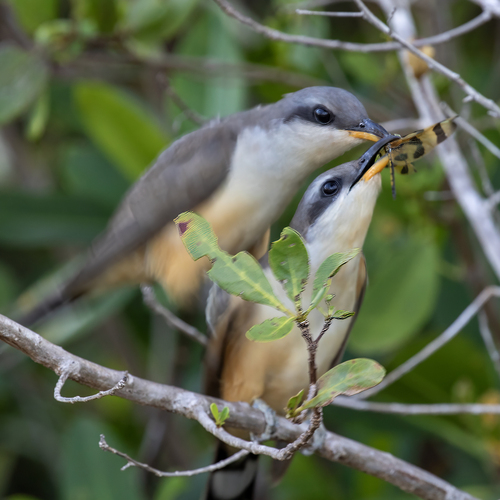
Mangrove Cuckoo (Coccyzus minor) Mangrove Cuckoo
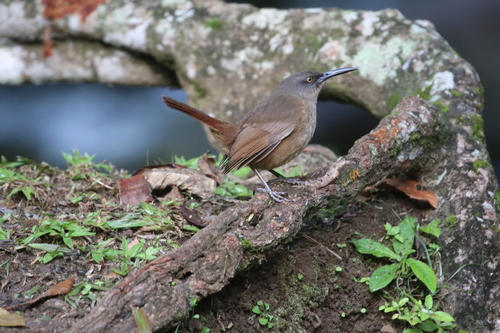
Brown Trembler (Cinclocerthia ruficauda) Brown Trembler

Media

Loading…

In short

The Mangrove Cuckoo and Brown Trembler are distinct in appearance and behavior. The Mangrove Cuckoo is a slender, long-tailed bird with a distinctive black mask and buffy underparts, while the Brown Trembler is a member of the Mimidae family, lacking the cuckoo's mask and tail pattern. These species are unlikely to be confused in the field due to their different habitats and behaviors.

Identification tips

Size

The Mangrove Cuckoo is 28–32 cm long, whereas the Brown Trembler's size is not specified but generally smaller and stockier.

Plumage

The Mangrove Cuckoo has a grayish crown, black auricular patch, and buffy underparts with a distinctive tail pattern of white-tipped outer rectrices. The Brown Trembler lacks these features, having more uniform brown plumage without a contrasting mask or tail pattern.

Behaviour

The Mangrove Cuckoo is often found perched quietly or moving slowly through mangroves, while the Brown Trembler is known for its distinctive trembling behavior and more active foraging.

Habitat

Mangrove Cuckoos are typically found in mangrove forests, while Brown Tremblers inhabit forested areas, often in more varied environments such as montane forests.

Voice

Mangrove Cuckoo calls are lower-pitched and slower compared to the Yellow-billed Cuckoo, but specific vocalization details for the Brown Trembler are not provided.

Submit a better description

Use the same sections as the comparison. Your text is published immediately.

The Mangrove Cuckoo and Brown Trembler are distinct in appearance and behavior. The Mangrove Cuckoo is a slender, long-tailed bird with a distinctive black mask and buffy underparts, while the Brown Trembler is a member of the Mimidae family, lacking the cuckoo's mask and tail pattern. These species are unlikely to be confused in the field due to their different habitats and behaviors.

  • Look for the black mask and buffy underparts on the Mangrove Cuckoo.
  • Note the distinctive tail pattern with white-tipped outer rectrices on the Mangrove Cuckoo.
  • Observe the trembling behavior of the Brown Trembler, which is a key behavioral trait.
  • Consider habitat: Mangrove Cuckoo in mangroves, Brown Trembler in varied forest environments.

The Mangrove Cuckoo is 28–32 cm long, whereas the Brown Trembler's size is not specified but generally smaller and stockier.

The Mangrove Cuckoo has a grayish crown, black auricular patch, and buffy underparts with a distinctive tail pattern of white-tipped outer rectrices. The Brown Trembler lacks these features, having more uniform brown plumage without a contrasting mask or tail pattern.

The Mangrove Cuckoo is often found perched quietly or moving slowly through mangroves, while the Brown Trembler is known for its distinctive trembling behavior and more active foraging.

Mangrove Cuckoos are typically found in mangrove forests, while Brown Tremblers inhabit forested areas, often in more varied environments such as montane forests.

Mangrove Cuckoo calls are lower-pitched and slower compared to the Yellow-billed Cuckoo, but specific vocalization details for the Brown Trembler are not provided.

Discard your changes?

You have unsaved edits. If you leave now, those changes will be lost.

Mangrove Cuckoo · Brown Trembler · My Tricky Birds