Birdr

Marsh Wren vs Bewick's Wren

Cistothorus palustris versus Thryomanes bewickii

Play a quiz with Marsh Wren and Bewick's Wren
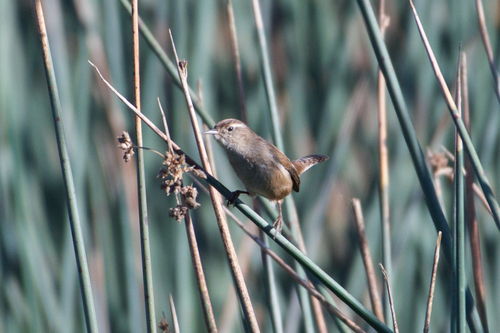
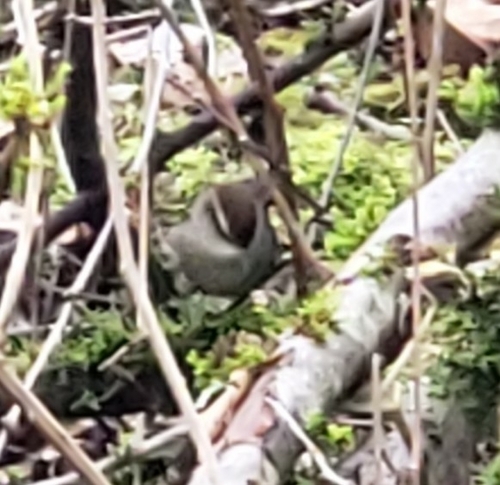
Marsh Wren (Cistothorus palustris) Marsh Wren
Bewick's Wren (Thryomanes bewickii) Bewick's Wren

Media

Loading…

In short

Marsh Wrens and Bewick's Wrens can be distinguished by their habitat preferences and plumage details. Marsh Wrens are more often found in marshy areas, while Bewick's Wrens prefer open woodlands and thickets. Key plumage differences include the Marsh Wren's more distinct streaking on the back and the Bewick's Wren's prominent white supercilium.

Identification tips

Size

Both species are small wrens, but size differences are subtle and not reliable for identification.

Plumage

Marsh Wrens have a more streaked back and a less pronounced supercilium compared to Bewick's Wrens, which have a bold white supercilium and plainer back. Bewick's Wrens also have a longer tail, often held upright.

Behaviour

Marsh Wrens are known for their complex singing and nest-building behaviors, often constructing multiple nests. Bewick's Wrens are more likely to be seen foraging low to the ground or in brush piles.

Habitat

Marsh Wrens are typically found in marshes and wetland areas, while Bewick's Wrens inhabit open woodlands, thickets, and areas with dense brush.

Voice

Both species have complex songs, but Marsh Wrens are noted for their almost continuous singing and countersinging duels. Bewick's Wrens have geographically variable songs, often learned from neighboring males.

Submit a better description

Use the same sections as the comparison. Your text is published immediately.

Marsh Wrens and Bewick's Wrens can be distinguished by their habitat preferences and plumage details. Marsh Wrens are more often found in marshy areas, while Bewick's Wrens prefer open woodlands and thickets. Key plumage differences include the Marsh Wren's more distinct streaking on the back and the Bewick's Wren's prominent white supercilium.

  • Habitat: Look for Marsh Wrens in wetlands; Bewick's Wrens are more likely in dry, brushy areas.
  • Plumage: Note the Marsh Wren's streaked back and less distinct supercilium versus the Bewick's Wren's bold white supercilium and plainer back.
  • Behavior: Marsh Wrens are often seen singing and building multiple nests; Bewick's Wrens forage low and may be seen in brush piles.
  • Vocalization: Listen for the Marsh Wren's continuous singing in marshes; Bewick's Wren songs vary by region.

Both species are small wrens, but size differences are subtle and not reliable for identification.

Marsh Wrens have a more streaked back and a less pronounced supercilium compared to Bewick's Wrens, which have a bold white supercilium and plainer back. Bewick's Wrens also have a longer tail, often held upright.

Marsh Wrens are known for their complex singing and nest-building behaviors, often constructing multiple nests. Bewick's Wrens are more likely to be seen foraging low to the ground or in brush piles.

Marsh Wrens are typically found in marshes and wetland areas, while Bewick's Wrens inhabit open woodlands, thickets, and areas with dense brush.

Both species have complex songs, but Marsh Wrens are noted for their almost continuous singing and countersinging duels. Bewick's Wrens have geographically variable songs, often learned from neighboring males.

Discard your changes?

You have unsaved edits. If you leave now, those changes will be lost.

Marsh Wren · Bewick's Wren · My Tricky Birds