Birdr

Marsh Wren vs Grey Silky-flycatcher

Cistothorus palustris versus Ptiliogonys cinereus

Play a quiz with Marsh Wren and Grey Silky-flycatcher
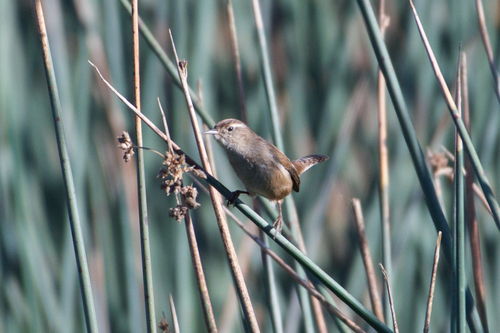
Marsh Wren (Cistothorus palustris) Marsh Wren
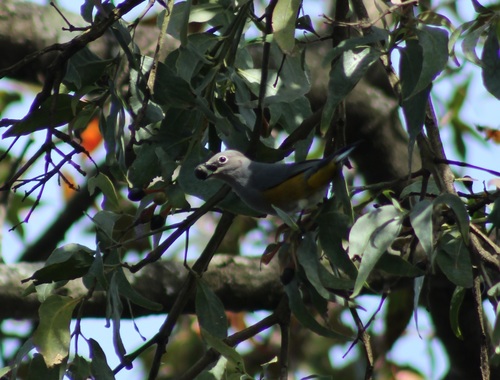
Grey Silky-flycatcher (Ptiliogonys cinereus) Grey Silky-flycatcher

Media

Loading…

In short

The Marsh Wren and Grey Silky-flycatcher are distinct in both appearance and behavior. The Marsh Wren is a small, active bird often found in marshes, while the Grey Silky-flycatcher is larger and more likely to be seen in open woodlands. Key differences include their plumage and habitat preferences.

Identification tips

  1. Habitat: Look for Marsh Wrens in marshy areas; Grey Silky-flycatchers are found in woodlands. 2. Size and Shape: Note the smaller size and compact shape of the Marsh Wren versus the larger, more elongated Grey Silky-flycatcher. 3. Plumage: Marsh Wrens have a white eyebrow stripe; Grey Silky-flycatchers are uniformly grey with a darker face. 4. Behavior: Observe the Marsh Wren's active, singing behavior in reeds, contrasting with the more subdued behavior of the Grey Silky-flycatcher.

Size

The Marsh Wren is smaller and more compact compared to the larger, more elongated Grey Silky-flycatcher.

Plumage

The Marsh Wren has a brown and buff coloration with a distinctive white eyebrow stripe, while the Grey Silky-flycatcher is mostly grey with a sleek, silky appearance and a darker face.

Behaviour

Marsh Wrens are known for their complex singing and nest-building behavior, often seen flitting through reeds. Grey Silky-flycatchers are more likely to be observed perched quietly or making short flights to catch insects.

Habitat

Marsh Wrens are typically found in marshes and wetlands, whereas Grey Silky-flycatchers prefer open woodlands and forest edges.

Voice

The Marsh Wren is a prolific singer with a varied and complex song, while the Grey Silky-flycatcher's vocalizations are less prominent and not as varied.

Submit a better description

Use the same sections as the comparison. Your text is published immediately.

The Marsh Wren and Grey Silky-flycatcher are distinct in both appearance and behavior. The Marsh Wren is a small, active bird often found in marshes, while the Grey Silky-flycatcher is larger and more likely to be seen in open woodlands. Key differences include their plumage and habitat preferences.

  1. Habitat: Look for Marsh Wrens in marshy areas; Grey Silky-flycatchers are found in woodlands. 2. Size and Shape: Note the smaller size and compact shape of the Marsh Wren versus the larger, more elongated Grey Silky-flycatcher. 3. Plumage: Marsh Wrens have a white eyebrow stripe; Grey Silky-flycatchers are uniformly grey with a darker face. 4. Behavior: Observe the Marsh Wren's active, singing behavior in reeds, contrasting with the more subdued behavior of the Grey Silky-flycatcher.

The Marsh Wren is smaller and more compact compared to the larger, more elongated Grey Silky-flycatcher.

The Marsh Wren has a brown and buff coloration with a distinctive white eyebrow stripe, while the Grey Silky-flycatcher is mostly grey with a sleek, silky appearance and a darker face.

Marsh Wrens are known for their complex singing and nest-building behavior, often seen flitting through reeds. Grey Silky-flycatchers are more likely to be observed perched quietly or making short flights to catch insects.

Marsh Wrens are typically found in marshes and wetlands, whereas Grey Silky-flycatchers prefer open woodlands and forest edges.

The Marsh Wren is a prolific singer with a varied and complex song, while the Grey Silky-flycatcher's vocalizations are less prominent and not as varied.

Discard your changes?

You have unsaved edits. If you leave now, those changes will be lost.

Marsh Wren · Grey Silky-flycatcher · My Tricky Birds