Birdr

Marsh Wren vs Saltmarsh Sparrow

Cistothorus palustris versus Ammospiza caudacuta

Play a quiz with Marsh Wren and Saltmarsh Sparrow
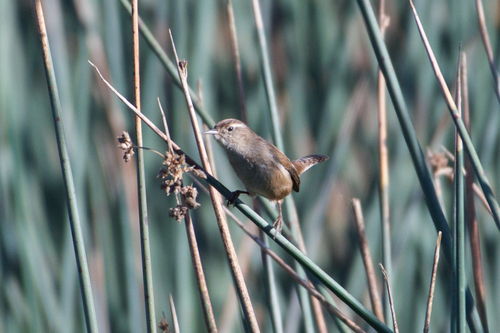
Marsh Wren (Cistothorus palustris) Marsh Wren
Saltmarsh Sparrow (Ammospiza caudacuta) Saltmarsh Sparrow

Media

Loading…

In short

The Marsh Wren and Saltmarsh Sparrow can be distinguished by their habitat preferences and vocalizations. Marsh Wrens are often found in freshwater marshes and are known for their complex songs, while Saltmarsh Sparrows are restricted to tidal salt marshes and have simpler calls.

Identification tips

  1. Habitat: Check if you're in a freshwater marsh (Marsh Wren) or a tidal salt marsh (Saltmarsh Sparrow). 2. Plumage: Look for the bold white eyebrow stripe of the Marsh Wren. 3. Behavior: Observe if the bird is singing prominently (Marsh Wren) or foraging quietly in dense grass (Saltmarsh Sparrow). 4. Vocalization: Listen for complex songs (Marsh Wren) versus simpler calls (Saltmarsh Sparrow).

Size

Both species are small, but the Marsh Wren is typically more compact and slightly smaller than the Saltmarsh Sparrow.

Plumage

Marsh Wrens have a distinctive bold white eyebrow stripe and a more uniform brown plumage with a barred back and wings. Saltmarsh Sparrows have a more streaked appearance with a buffy face and a less pronounced eyebrow stripe.

Behaviour

Marsh Wrens are known for their aggressive nest-building and singing behavior, often seen perched atop reeds. Saltmarsh Sparrows are more secretive, foraging on the ground and in dense vegetation.

Habitat

Marsh Wrens inhabit freshwater marshes with cattails and reeds, while Saltmarsh Sparrows are found in tidal salt marshes with Spartina grasses.

Voice

Marsh Wrens have a complex and varied song repertoire, often singing continuously. Saltmarsh Sparrows have simpler, less varied calls.

Submit a better description

Use the same sections as the comparison. Your text is published immediately.

The Marsh Wren and Saltmarsh Sparrow can be distinguished by their habitat preferences and vocalizations. Marsh Wrens are often found in freshwater marshes and are known for their complex songs, while Saltmarsh Sparrows are restricted to tidal salt marshes and have simpler calls.

  1. Habitat: Check if you're in a freshwater marsh (Marsh Wren) or a tidal salt marsh (Saltmarsh Sparrow). 2. Plumage: Look for the bold white eyebrow stripe of the Marsh Wren. 3. Behavior: Observe if the bird is singing prominently (Marsh Wren) or foraging quietly in dense grass (Saltmarsh Sparrow). 4. Vocalization: Listen for complex songs (Marsh Wren) versus simpler calls (Saltmarsh Sparrow).

Both species are small, but the Marsh Wren is typically more compact and slightly smaller than the Saltmarsh Sparrow.

Marsh Wrens have a distinctive bold white eyebrow stripe and a more uniform brown plumage with a barred back and wings. Saltmarsh Sparrows have a more streaked appearance with a buffy face and a less pronounced eyebrow stripe.

Marsh Wrens are known for their aggressive nest-building and singing behavior, often seen perched atop reeds. Saltmarsh Sparrows are more secretive, foraging on the ground and in dense vegetation.

Marsh Wrens inhabit freshwater marshes with cattails and reeds, while Saltmarsh Sparrows are found in tidal salt marshes with Spartina grasses.

Marsh Wrens have a complex and varied song repertoire, often singing continuously. Saltmarsh Sparrows have simpler, less varied calls.

Discard your changes?

You have unsaved edits. If you leave now, those changes will be lost.

Marsh Wren · Saltmarsh Sparrow · My Tricky Birds