Birdr

Masked Shrike vs Woodchat Shrike

Lanius nubicus versus Lanius senator

Play a quiz with Masked Shrike and Woodchat Shrike
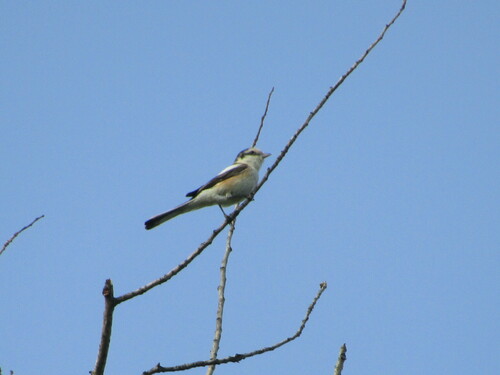
Masked Shrike (Lanius nubicus) Masked Shrike
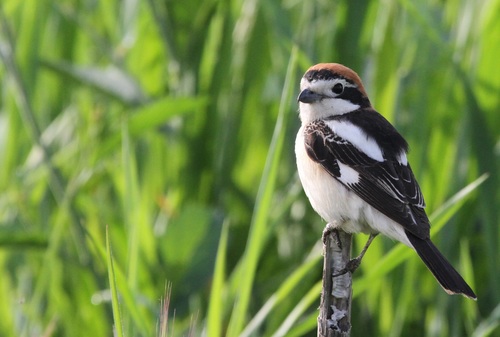
Woodchat Shrike (Lanius senator) Woodchat Shrike

Media

Loading…

In short

The Masked Shrike and Woodchat Shrike can be distinguished by their head patterns and coloration. The Masked Shrike features a striking black mask and white underparts, while the Woodchat Shrike is notable for its deep-rufous crown and nape. Both species are found in similar habitats but have distinct plumage characteristics.

Identification tips

Size

Both species are similar in size, typical of shrikes, with no significant size difference to aid in identification.

Plumage

The Masked Shrike has a black mask extending from the forehead through the eyes, white underparts, and a white rump. The Woodchat Shrike features a deep-rufous crown and nape, with a black mask that does not extend as far as in the Masked Shrike, and more extensive white on the wings.

Behaviour

Both species are often seen perched upright on exposed branches, hunting from these vantage points. They share similar hunting behaviors, capturing prey on the ground.

Habitat

Both shrikes inhabit open woodlands and scrub areas. The Masked Shrike is more commonly found in the eastern Mediterranean and the Middle East, while the Woodchat Shrike is found across the Mediterranean Basin.

Voice

Vocalizations are not the most reliable distinguishing feature in the field, as both species have similar calls typical of shrikes.

Submit a better description

Use the same sections as the comparison. Your text is published immediately.

The Masked Shrike and Woodchat Shrike can be distinguished by their head patterns and coloration. The Masked Shrike features a striking black mask and white underparts, while the Woodchat Shrike is notable for its deep-rufous crown and nape. Both species are found in similar habitats but have distinct plumage characteristics.

  • Look for the black mask and white underparts of the Masked Shrike.
  • Note the deep-rufous crown and nape of the Woodchat Shrike.
  • Observe the white rump of the Masked Shrike, which contrasts with the Woodchat's more extensive white on the wings.
  • Consider geographic location if uncertain, as their ranges overlap but have distinct core areas.

Both species are similar in size, typical of shrikes, with no significant size difference to aid in identification.

The Masked Shrike has a black mask extending from the forehead through the eyes, white underparts, and a white rump. The Woodchat Shrike features a deep-rufous crown and nape, with a black mask that does not extend as far as in the Masked Shrike, and more extensive white on the wings.

Both species are often seen perched upright on exposed branches, hunting from these vantage points. They share similar hunting behaviors, capturing prey on the ground.

Both shrikes inhabit open woodlands and scrub areas. The Masked Shrike is more commonly found in the eastern Mediterranean and the Middle East, while the Woodchat Shrike is found across the Mediterranean Basin.

Vocalizations are not the most reliable distinguishing feature in the field, as both species have similar calls typical of shrikes.

Discard your changes?

You have unsaved edits. If you leave now, those changes will be lost.

Masked Shrike · Woodchat Shrike · My Tricky Birds