
McKay's Bunting vs Pine Bunting
Plectrophenax hyperboreus versus Emberiza leucocephalos
Play a quiz with McKay's Bunting and Pine Bunting
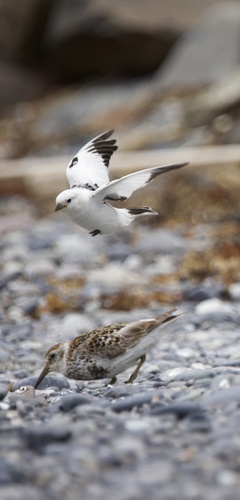
McKay's Bunting
Pine Bunting
In short
McKay's Bunting is primarily distinguished by its strikingly white plumage with limited black on the wings and tail, whereas the Pine Bunting has a more varied plumage with brown and rufous tones. These species are not closely related, with McKay's Bunting belonging to the Calcariidae family and Pine Bunting to the Emberizidae family.
Identification tips
1. Plumage: Look for the predominantly white plumage of McKay's Bunting, especially in males, compared to the brown and rufous tones of Pine Bunting. 2. Habitat: Consider the location; McKay's Bunting is found in the Bering Sea region, while Pine Bunting is Eurasian. 3. Family Traits: Remember the family differences; McKay's is a Calcariidae with a simpler color pattern, while Pine is an Emberizidae with more complex markings.
Size
Both species are similar in size, typical of small passerines.
Plumage
McKay's Bunting is predominantly white with black only on the wing-tips, scapulars, and tail, making it the whitest North American passerine. In contrast, Pine Bunting exhibits brown and rufous tones, particularly on the head and back, with a more streaked appearance.
Behaviour
Behavioral details for McKay's Bunting are limited, but it is expected to be similar to the Snow Bunting. Pine Bunting, like other Emberizidae, may exhibit typical bunting foraging behavior.
Habitat
McKay's Bunting breeds on isolated islands in the Bering Sea, while Pine Bunting is found in open woodlands and scrubby areas across parts of Eurasia.
Voice
Vocalizations are not well-documented for McKay's Bunting, but it is likely similar to Snow Bunting. Pine Bunting has a song and call typical of Emberizidae, which includes a series of clear, whistled notes.