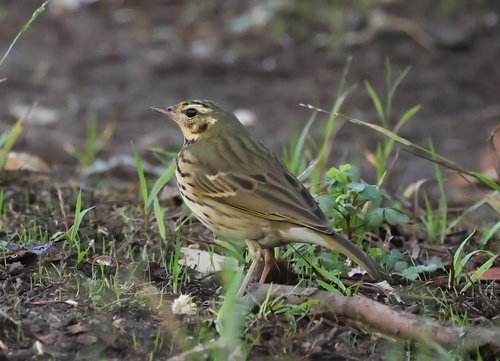
Meadow Pipit vs Olive-backed Pipit
Anthus pratensis versus Anthus hodgsoni
Play a quiz with Meadow Pipit and Olive-backed Pipit

Meadow Pipit
Olive-backed Pipit
In short
The Meadow Pipit and Olive-backed Pipit are similar in size and structure, but the Olive-backed Pipit is distinguished by its more pronounced and consistent supercilium and olive-toned upperparts. Both species have streaked underparts, but the Meadow Pipit tends to have more extensive streaking on the flanks.
Identification tips
- Look for the distinct supercilium on the Olive-backed Pipit, more pronounced than in the Meadow Pipit. 2. Note the olive tone of the Olive-backed Pipit's upperparts compared to the more earth-brown of the Meadow Pipit. 3. Check the flank streaking: more extensive in the Meadow Pipit. 4. Consider habitat: Olive-backed Pipits are more likely in wooded areas, while Meadow Pipits prefer open fields.
Size
Both species are similar in size, around 14.5–15 cm in length.
Plumage
The Meadow Pipit has earth-brown or greenish olive-brown upperparts with broad brownish-black streaks, while the Olive-backed Pipit has more olive-toned upperparts and a more distinct, continuous supercilium. The Meadow Pipit shows more extensive streaking on the flanks.
Behaviour
Both species exhibit similar ground-foraging behavior, often seen walking or running in search of invertebrates.
Habitat
Meadow Pipits are often found in open habitats with short vegetation, while Olive-backed Pipits prefer forested or wooded areas, especially during migration.
Voice
The Meadow Pipit's song is a series of uniform notes that increase in speed and pitch, often ending with a flourish, while the Olive-backed Pipit's song and calls are less documented but generally include high-pitched, thin notes.