
Meadow Pipit vs Red-throated Pipit
Anthus pratensis versus Anthus cervinus
Play a quiz with Meadow Pipit and Red-throated Pipit
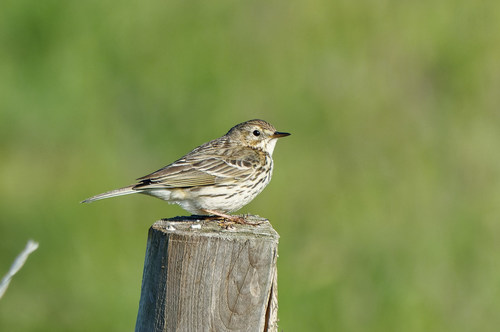 Meadow Pipit
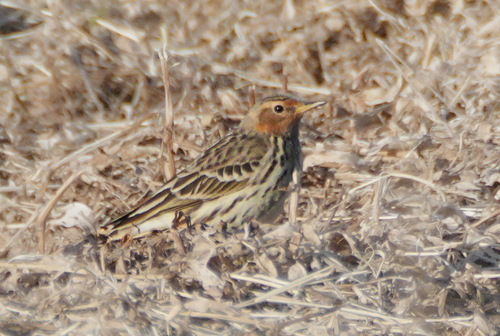 Red-throated Pipit
In short
The most reliable field mark between Meadow Pipit and Red-throated Pipit is the brick-red face and throat of adult Red-throated Pipits in breeding plumage, which Meadow Pipit never shows. Outside the breeding season or in immature birds, separation is much trickier: Red-throated Pipit is more heavily and extensively streaked above and below, with paler mantle stripes and a more contrasting, striped look overall. Meadow Pipit is browner above, buff below, with finer streaking and a long hind claw. Both are similar in size and shape, so careful attention to streaking pattern and seasonal plumage is key, especially in autumn and winter when Red-throated Pipit loses its red coloration.
Identification tips
- Breeding adult Red-throated Pipit shows a brick-red face and throat—this is diagnostic and never shown by Meadow Pipit. Look for this in spring and early summer.
- Outside breeding plumage, Red-throated Pipit is much more heavily streaked above (cap, back, rump) and below (flanks, chest) than Meadow Pipit. Focus on the density and extent of streaking, especially in autumn and winter.
- Red-throated Pipit has pale mantle stripes that can give it a more contrasting, striped look from above, especially in fresh plumage. Meadow Pipit is browner and less contrasting on the back.
- Meadow Pipit is buff below with finer, more limited streaking, while Red-throated Pipit is whiter below with bold black streaks.
- Look for the long hind claw on Meadow Pipit—it is longer than the rest of the hind toes and can sometimes be seen in good views on the ground or perched.
- Tail pattern is not strongly diagnostic, but Meadow Pipit has narrow white outer tail edges; this is subtle and not always visible.
- Flight style differs slightly: Red-throated Pipit has a strong, direct flight, while Meadow Pipit often performs short song flights with a repetitive song.
- Calls differ: Meadow Pipit gives a faint 'tsi-tsi', while Red-throated Pipit gives a sharper 'psii' in flight. Listen carefully if birds are flying over.
- Habitat and range context can help: Red-throated Pipit is a rare migrant or vagrant in western Europe; if you are in typical Meadow Pipit habitat in western Europe, Meadow Pipit is much more likely.
- In autumn and winter, beware confusion: Red-throated Pipit loses its red and looks much more like Meadow Pipit, but still shows heavier streaking and a more contrasting, striped look.
- Both species are similar in size and shape; do not rely on overall size or jizz alone.
- Juvenile and immature plumages are not described as having distinctive upperwing or flight marks in the sources, so focus on streaking and mantle pattern.
- Facial pattern is not strongly diagnostic outside breeding plumage, but Red-throated Pipit may appear slightly more marked due to the heavier streaking.
- Both species can be seen walking or running on the ground and perching on low vegetation; behavior is not a strong separator.
- If in doubt, prioritize streaking density and, in spring, the presence or absence of red on the face and throat.
Size
Both species are small pipits with very similar measurements: Meadow Pipit is 14.5–15 cm in length and weighs 15–22 g [wikipedia]. Red-throated Pipit is also a small pipit, and no significant size difference is noted in the sources. Structure is similar, but Meadow Pipit has a notably long hind claw, which can sometimes be seen in the field.
Plumage
In adult breeding plumage, Red-throated Pipit stands out with a brick-red face and throat—this is absent in Meadow Pipit at all ages and seasons. Outside the breeding season and in immatures, Red-throated Pipit becomes much harder to separate, but is still more heavily streaked above (cap, back, rump) and below (flanks, chest) than Meadow Pipit, and shows pale mantle stripes that can give a more contrasting, striped appearance. Meadow Pipit is brown above and buff below, with darker barring but less extensive streaking, and its tail has narrow white outer edges. Both species are similar on the ground when not in breeding plumage, but Red-throated Pipit always appears more boldly streaked, especially on the flanks and back. No distinctive upperwing or flight pattern differences are described for juveniles or immatures in the sources.
Behaviour
Both species are ground-dwelling pipits with similar feeding and movement habits, often walking or running in open areas. Red-throated Pipit is described as having a strong, direct flight, while Meadow Pipit performs short song flights with a repetitive song. Both can be seen perched on low vegetation or on the ground, and their jizz is generally similar.
Habitat
Meadow Pipit breeds widely across the Palearctic in open country, including grasslands and moorlands, and is often abundant in western Europe. Red-throated Pipit breeds much further north, in the far north of Europe and the Palearctic, and is a rare vagrant to western Europe. In winter, Meadow Pipit is found in southern Europe, North Africa, and southwest Asia, while Red-throated Pipit winters in Africa and Southeast Asia. In Western Europe, Red-throated Pipit is much rarer and usually only seen as a migrant or vagrant.
Voice
Meadow Pipit gives a faint 'tsi-tsi' call and a simple, repetitive song that accelerates towards the end. Red-throated Pipit gives a characteristic 'psii' call in flight. The songs are not described in detail for Red-throated Pipit, but the calls are subtly different and may help with identification if heard well.