
Meadow Pipit vs Rock Pipit
Anthus pratensis versus Anthus petrosus
Play a quiz with Meadow Pipit and Rock Pipit
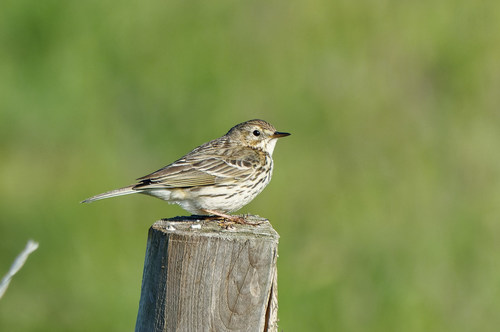 Meadow Pipit
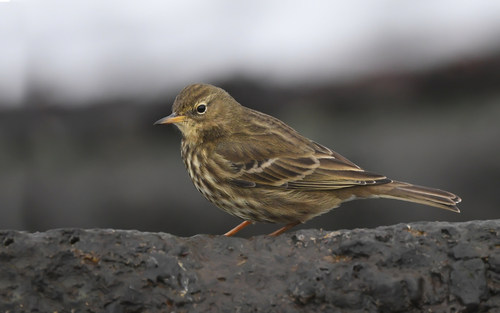 Rock Pipit
In short
The most reliable field mark between Meadow Pipit and Rock Pipit is the color and definition of the outer tail feathers in flight: Meadow Pipit shows narrow, crisp white edges, while Rock Pipit has dusky or dark outer tail feathers. Juvenile and winter birds are especially tricky, but Rock Pipit is always bulkier, darker, and has dark legs versus the Meadow Pipit's pinkish legs. Habitat is also a strong clue: Meadow Pipit is found in open fields and moorland, while Rock Pipit sticks to rocky coasts. Structure and leg color, along with tail pattern, are your best bets when plumage is ambiguous.
Identification tips
- Tail pattern in flight: Meadow Pipit shows narrow, crisp white outer tail edges; Rock Pipit's outer tail feathers are dusky or dark with little or no white. This is the single most reliable field mark for all ages and seasons.
- Leg color: Meadow Pipit has pale pinkish or yellowish legs; Rock Pipit has dark brown or blackish legs. Leg color is visible on perched birds and is especially helpful when tail is obscured.
- Overall coloration: Meadow Pipit is paler above and below, with buff underparts and finer, more defined streaking. Rock Pipit is darker, with smoky-olive upperparts and heavier, blurrier streaks below. This is most useful in good light and at close range.
- Size and structure: Rock Pipit is bulkier, longer, and heavier, with a more robust build and longer wings. Meadow Pipit is smaller, slimmer, and more delicate, with a finer bill. Use this when both species are present for direct comparison.
- Facial markings: Both species have weak facial markings, but Meadow Pipit may show a slightly stronger supercilium. This is subtle and unreliable, especially in winter or for immatures.
- Eye-ring: Rock Pipit has a pale eye-ring, but this is not always obvious in the field and should not be relied on alone.
- Habitat: If the bird is on a rocky coast, especially among boulders or seaweed, it's almost certainly a Rock Pipit. In open fields, moorland, or grassland, Meadow Pipit is the default.
- Song and calls: Meadow Pipit's song is a simple, repetitive series that accelerates at the end; Rock Pipit's song is more complex, with tinkling notes and a trill. Calls are subtly different but require experience to separate.
- Juvenile confusion: Juvenile Rock Pipits can look browner and more streaked above, superficially resembling Meadow Pipit, but still lack the crisp white tail edges and have dark legs.
- Wing pattern: Neither species shows strong wing panels or contrasting upperwing marks in any age, so rely on tail and leg color for separation.
- Display flight: Meadow Pipit's song flight is short and repetitive; Rock Pipit's display is a higher, parachuting descent. This is only useful during the breeding season.
- Bill color and shape: Meadow Pipit has a thin, fine bill; Rock Pipit's bill is slightly heavier and darker, but this is a subtle difference best used in combination with other marks.
- Flock size: Meadow Pipit is more likely to be seen in flocks outside the breeding season; Rock Pipit is usually solitary or in pairs.
- Seasonal context: In winter, both species can look drabber, but habitat and tail pattern remain reliable. Be cautious with Rock Pipit subspecies (littoralis) in spring, as they can show pinkish underparts and a pale supercilium, but tail and leg color still separate them from Meadow Pipit.
- Pitfalls: Do not rely on streaking alone; both species are streaked, but the quality and definition differ. Always check tail pattern and leg color before making a call.
Size
Rock Pipit is noticeably larger and heavier than Meadow Pipit. Rock Pipit measures 16.5–17 cm in length and weighs 18–32.5 g, while Meadow Pipit is smaller at 14.5–15 cm and 15–22 g. In the field, Rock Pipit often looks bulkier and longer-winged, with a heavier, more robust build. Meadow Pipit appears more delicate and slim, with a finer bill and a lighter overall impression.
Plumage
For all ages, the most diagnostic plumage mark is the tail: Meadow Pipit has narrow, crisp white outer tail edges (visible in flight and sometimes when perched), while Rock Pipit's outer tail feathers are dusky or dark, lacking obvious white. Juvenile and first-winter Rock Pipits can appear browner and more streaked above, sometimes resembling Meadow Pipit, but they still lack the Meadow Pipit's clean white tail edges. Meadow Pipit is generally paler and more buff below, with finer, more defined streaking, while Rock Pipit is darker, with smoky-olive upperparts and heavier, blurrier streaks below. Rock Pipit also has a pale eye-ring and dark legs, while Meadow Pipit shows pinkish or yellowish legs. Subtle differences in facial markings are unreliable in the field, especially in winter or for immatures.
Behaviour
Both species walk and feed on the ground, but Rock Pipit is highly territorial year-round and often seen alone or in pairs on rocky shorelines. Meadow Pipit is more likely to be seen in loose flocks, especially outside the breeding season, and frequently performs fluttering song flights over open country. Rock Pipit's display flight is a short, parachuting descent from a moderate height (15–30 m), while Meadow Pipit's song flight is shorter and more repetitive.
Habitat
Habitat is a strong separator: Meadow Pipit is found in open country, grasslands, moorland, and fields, rarely venturing to rocky coastal areas. Rock Pipit is almost exclusively coastal, breeding and feeding on rocky shores, jetties, and seaweed-covered rocks. If you see a pipit inland or in open fields, it's almost certainly a Meadow Pipit; on a rocky coast, especially among boulders or seaweed, Rock Pipit is the default.
Voice
Meadow Pipit gives a faint 'tsi-tsi' call and a simple, repetitive song that accelerates toward the end. Rock Pipit's flight call is a shrill 'pseep', intermediate in tone between Meadow Pipit and Water Pipit. Its song is more complex: a series of tinkling 'cheepa' notes, followed by rising 'gee' calls and ending with a short trill. In practice, calls can be hard to separate unless you are familiar with both species.