
Meadow Pipit vs Tree Pipit
Anthus pratensis versus Anthus trivialis
Play a quiz with Meadow Pipit and Tree Pipit
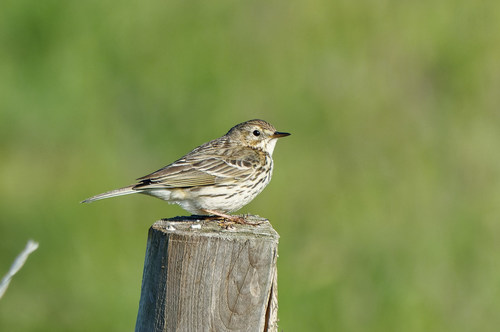 Meadow Pipit
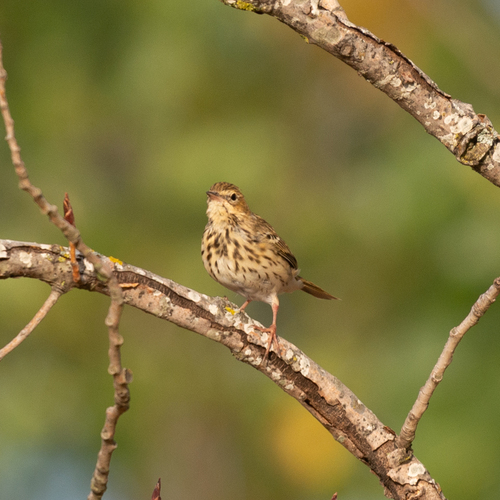 Tree Pipit
In short
The most reliable field mark to separate Meadow Pipit from Tree Pipit is the combination of structure and plumage: Meadow Pipit has a distinctly longer hind claw and a thinner bill, while Tree Pipit shows a heavier bill and a much shorter hind claw. In plumage, Tree Pipit has a bolder contrast between its buff breast and white belly, and its upperparts are less heavily streaked than Meadow Pipit. Tree Pipit is more likely to be seen perched in trees, while Meadow Pipit typically stays on the ground or low vegetation. Their calls and song flights are also notably different, with Tree Pipit giving a strong 'spek' call and a parachuting song flight, while Meadow Pipit’s call is a weak 'tsi-tsi' and its song flight is simpler and more repetitive.
Identification tips
- Hind claw length: Meadow Pipit has a very long hind claw, often longer than the hind toe itself; Tree Pipit’s is much shorter. This is a key field mark when the legs are visible, especially on perched birds.
- Bill structure: Tree Pipit has a noticeably heavier and broader bill, while Meadow Pipit’s bill is finer and more delicate. This is subtle but useful with good views.
- Breast and belly contrast: Tree Pipit shows a strong contrast between a buff breast (with black streaks) and a much whiter belly. Meadow Pipit is buff below with streaks extending further down the flanks, so the contrast is less marked.
- Upperpart streaking: Meadow Pipit is more heavily streaked above, giving a generally more mottled appearance. Tree Pipit is less streaked and can look plainer on the back.
- Facial markings: Tree Pipit has stronger facial markings, including a more obvious supercilium (eyebrow) and a more defined malar stripe. Meadow Pipit’s face is plainer.
- Leg color: Both species have pale legs, but Meadow Pipit’s are often described as pinkish-yellow, which can help in good light.
- Tail pattern: Both have brown tails with white edges, but this is not a strong separator between the two.
- Perching behavior: Tree Pipit frequently perches in trees or on wires, especially when singing. Meadow Pipit almost always stays on the ground or in low vegetation.
- Song flight: Tree Pipit’s song flight is distinctive: it rises from a tree, then parachutes down with wings held stiff, song drawn out at the end. Meadow Pipit’s song flight is shorter, more fluttery, and the song accelerates towards the finish.
- Call: Listen for the difference: Meadow Pipit’s call is a faint 'tsi-tsi', while Tree Pipit’s is a strong, sharp 'spek'.
- Habitat: In woodland edge, clearings, or areas with scattered trees, suspect Tree Pipit; in open moorland, grassland, or coastal marsh, Meadow Pipit is far more likely.
- Size and jizz: Tree Pipit is slightly larger and more robust, but this is subtle. Meadow Pipit is more delicate and often appears more nervous and fluttery in movement.
- Seasonal context: Both species are migrants, but Tree Pipit is a long-distance migrant wintering in Africa and southern Asia, while Meadow Pipit winters in southern Europe, North Africa, and southwest Asia, with some resident in western Europe. Timing and location can help, especially outside the breeding season.
- Pitfalls: Juvenile and first-winter birds do not show distinctive wing patterns to separate the two; rely on structure and overall plumage. Beware of local variation: Meadow Pipits in western Scotland and Ireland can be darker than usual, but still show the long hind claw and finer bill.
- When in doubt: If you cannot see the hind claw or bill well, use a combination of habitat, perching behavior, and the contrast between breast and belly to make your best guess.
Size
Tree Pipit is slightly larger and heavier than Meadow Pipit, with an average body mass of 23.5 g compared to Meadow Pipit's typical range of 15–22 g [wikidata]. In the field, this difference is subtle and often hard to judge unless both species are side by side. Both are small, slender pipits, but Tree Pipit may appear a bit more robust, especially in the head and bill.
Plumage
There are no distinctive juvenile or first-winter upperwing patterns described for either species in the sources, so separation relies on overall plumage and structure at all ages. Meadow Pipit is brown above and buff below, with dense, dark streaking on the breast and flanks, and a brown tail edged narrowly with white. Tree Pipit is also brown above but with less heavy streaking, and the streaks on the underparts are more confined to the buff breast, which contrasts sharply with a much whiter belly. Tree Pipit’s bill is heavier and the face shows stronger markings. The hind claw is a key structural plumage feature: Meadow Pipit’s is conspicuously long, while Tree Pipit’s is much shorter. These differences are present in all plumages, though the contrast between breast and belly is most obvious in fresh adults.
Behaviour
Tree Pipit is much more likely to perch on trees, wires, or high shrubs, often singing from an elevated perch and launching into its characteristic parachuting song flight. Meadow Pipit is typically seen on the ground or low in grass, rarely perching high. In flight, Meadow Pipit’s jizz is more fluttery and less direct, while Tree Pipit’s flight is stronger and more purposeful. Both species perform song flights, but Tree Pipit's is more elaborate, rising from a tree and parachuting down with wings held stiffly.
Habitat
Meadow Pipit prefers open country: grasslands, moorland, and coastal marshes, and is rarely found in wooded areas. Tree Pipit, as the name suggests, favors habitats with a wooded component—open woodland, edges of forests, clearings with scattered trees, or heath with some tree cover. If you see a pipit in a tree or singing from a high perch in a woodland edge, Tree Pipit is much more likely; on open moor or grassland, Meadow Pipit dominates.
Voice
The calls are quite distinct: Meadow Pipit gives a weak, high-pitched 'tsi-tsi', while Tree Pipit’s call is a much stronger, sharper 'spek'. Their songs also differ: Meadow Pipit’s song is a simple, repetitive series that accelerates towards the end, usually delivered in a short, fluttering song flight. Tree Pipit’s song is more elaborate, drawn out towards the end, and delivered during a parachuting descent from a tree or high perch.