
Meadow Pipit vs Water Pipit
Anthus pratensis versus Anthus spinoletta
Play a quiz with Meadow Pipit and Water Pipit
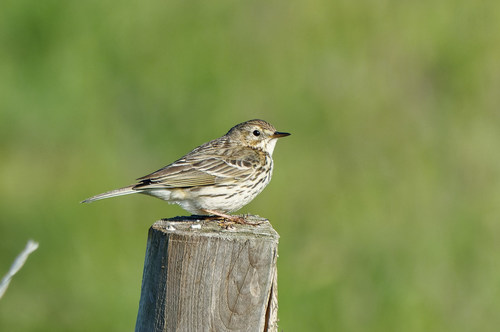
Meadow Pipit
Water Pipit
In short
The Meadow Pipit (Anthus pratensis) and Water Pipit (Anthus spinoletta) are two similar-looking species that can be distinguished by their size, plumage, vocalizations, and habitat preferences. While both are small pipits with streaked plumage, the Meadow Pipit is slightly smaller and has a more earth-toned coloration, while the Water Pipit has a more distinct greyish appearance and often displays a pinkish hue on its underparts.
Identification tips
- Birds of the World Similar-Species Diagnostics:
- The Water Pipit is said to have a more melodious and louder song compared to the Meadow Pipit, which has a simpler and less melodious song. The calls of the Water Pipit are described as more grating than those of the Meadow Pipit. These observations can help to differentiate between the two species in the field.
-
From the identification section: The Water Pipit has a contrasting broad whitish supercilium and a pale pinkish-buff belly, while the Meadow Pipit has a narrower malar stripe and a more uniformly streaked underbelly.
-
AI Field Diagnostics:
- Look for size: When observing these birds, the Water Pipit is slightly larger and appears bulkier than the Meadow Pipit.
- Check the color: The Water Pipit’s greyish-brown upperparts and pale pinkish-buff underparts are key identifiers. In contrast, the Meadow Pipit's earth-toned coloration and broader streaking are distinctive.
- Observe behavior: If a pipit is feeding around water bodies or in more mountainous terrain, it's likely to be a Water Pipit. Conversely, if seen in open grasslands or fields, it’s likely a Meadow Pipit.
- Listen carefully: The melodic and complex song of the Water Pipit can be a clear indicator, whereas the Meadow Pipit has a simpler and quieter song. The calls are also different, with the Meadow Pipit sounding higher-pitched and softer compared to the grating calls of the Water Pipit.
- Be aware of the habitats: If you’re in a wetland or high-altitude area, lean towards identifying the Water Pipit; if you’re in a grassy field, it’s more likely to be a Meadow Pipit.
These tips should help birdwatchers effectively distinguish between the Meadow Pipit and Water Pipit in the field.
Size
- Meadow Pipit: Measures 14.5–15 cm in length and weighs between 14.5–22 g (mean male 18.6 g, female 19.5 g).
- Water Pipit: Slightly larger, measuring 15–17 cm in length and weighing 18.7–23 g.
Plumage
- Meadow Pipit: Has an earth-brown or greenish olive-brown coloration with broad brownish-black streaks on the head, mantle, scapulars, and back. The underparts are whitish to greyish or yellowish-buff with broad streaks. It features a narrow blackish malar stripe and a pale eyering.
- Water Pipit: Exhibits a mid-grey to brownish-grey head and nape, with a contrasting broad whitish supercilium. The upperparts are greyish-brown with faint dark streaks, and the underparts are whitish with a pale pinkish-buff hue, occasionally with slight dark streaking on the breast.
Behaviour
- Meadow Pipit: Generally forages on the ground in short vegetation, running or walking, and is more likely to form small to large flocks during migration. It is territorial during breeding and often sings from the ground or during a song flight.
- Water Pipit: More versatile in foraging, it can catch flying insects and often feeds around burrow entrances of marmots in harsh weather. Typically forages singly or in pairs, and can also be seen in small groups.
Habitat
- Meadow Pipit: Prefers open grassland, heathland, and areas with short vegetation, usually less than 10 cm tall.
- Water Pipit: Favours wetlands, riverbanks, and areas near water bodies. It is often found in alpine habitats and moist meadows.
Voice
- Meadow Pipit: Its song consists of a series of uniform notes starting quietly and building in volume and speed, with calls that are high-pitched and squeaky, such as “psiip” or “pheet”.
- Water Pipit: Produces a more melodious and tinkling song with a rattling series of 4–5 segments, including notes like “dwis” and “wiss-wiss”. Its call is grating and harsher compared to the Meadow Pipit.