
Merlin vs Eurasian Hobby
Falco columbarius versus Falco subbuteo
Play a quiz with Merlin and Eurasian Hobby
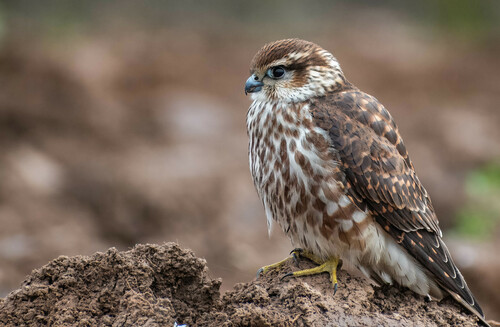 Merlin
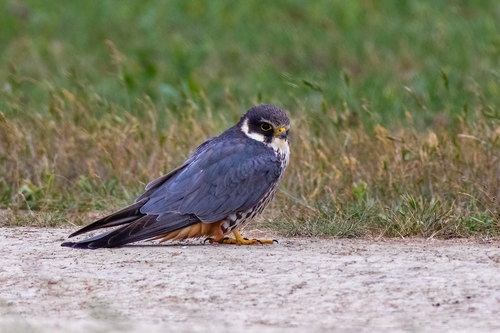 Eurasian Hobby
In short
The most reliable field mark to separate Merlin from Eurasian Hobby is overall structure and flight style: Merlins are compact, heavily built falcons with relatively short, broad wings and a strong, direct flight, while Eurasian Hobbies are slim, elegant, and long-winged, often recalling a giant swift in flight. Juvenile and female Merlins are brown above with streaked underparts, but lack the Hobby's distinctive rufous 'trousers' and clean white throat. Adult male Merlins are blue-gray above, contrasting with the Hobby's uniform slate-gray upperparts and bold facial pattern. In perched birds, look for the Hobby's longer wings and tail, and in flight, note the Hobby's sickle-shaped wings and buoyant, acrobatic jizz. Both species can overlap in size, but the Hobby is generally longer-winged and more graceful.
Identification tips
- Flight structure: Merlins are compact with short, broad wings and a relatively short tail; Hobbies are slim, with long, pointed, sickle-shaped wings and a long, square-tipped tail. In flight, Hobby's wings often appear to bend back at the wrist, giving a swift-like profile.
- Jizz in flight: Merlins fly with rapid, powerful wingbeats and little gliding, often low to the ground; Hobbies are buoyant, agile, and acrobatic, frequently soaring or gliding with wings swept back, and often feeding on the wing.
- Perched structure: When perched, the Hobby's long wings reach or exceed the tail tip, giving a long, elegant look. Merlin's wings are shorter and do not reach the tail tip, and the bird appears more thickset.
- Facial pattern: Hobbies have a bold face with a dark crown and two short, black moustache stripes, and a clean white throat. Merlins have a much less marked face, with only faint supercilium and malar stripe, and the throat is not clean white.
- Underparts: Adult Merlins are heavily streaked below, with buff to orange tones; Hobbies have whitish underparts with black streaks, but the throat is always clean white and the thighs/undertail are bright, unstreaked rufous ('trousers').
- Tail pattern: Merlin's tail shows several broad, dark bands with a black tip and narrow white terminal band, visible in all ages. Hobby's tail is more uniformly gray with less distinct banding.
- Upperparts: Adult male Merlins are blue-gray above; females and juveniles are brownish-gray. Hobbies are slate-gray above in adults, browner and more scaled in juveniles.
- Juvenile confusion: Juvenile Merlins are brown above and streaked below but lack the Hobby's rufous thighs and bold facial pattern. Juvenile Hobbies are browner above with scaled upperparts and streaked buffy thighs, but even they show some rufous on the undertail.
- Size and shape: Hobbies are longer-winged and longer-tailed, appearing larger and more graceful, especially in flight. Merlins are heavier-bodied for their length and look more muscular.
- Feeding behavior: Hobbies often feed on the wing, catching insects and birds and eating in flight; Merlins rarely feed in flight and more often hunt by direct pursuit.
- Season and context: Hobbies are mostly present in Europe during the warmer months and are migratory; Merlins can be found year-round in parts of their range, including winter in open lowlands and urban areas.
- Habitat cues: In open country with scattered trees or marshes in summer, Hobby is more likely; in northern or upland open habitats, especially outside summer, Merlin is more likely.
- Sexual dimorphism: Male Merlins are blue-gray above; females and juveniles are brownish. Hobbies show little sexual dimorphism—both sexes look alike.
- Leg color: Both species have yellow legs and feet, so this is not useful for separation.
- Voice: Not diagnostic from the available notes.
Size
Both species are small falcons, but the Eurasian Hobby is slightly larger and noticeably more slender. Merlin averages 187 g in body mass, while Hobby averages 211 g. Merlin measures 24–33 cm in length with a 50–73 cm wingspan, whereas Hobby is 29–36 cm long with a 74–84 cm wingspan. The Hobby's longer wings and tail are especially apparent in flight or when perched, where the wingtips often reach or exceed the tail tip. Merlins appear more robust, with a heavier body relative to their length and shorter, broader wings.
Plumage
- Juvenile/immature plumage: Juvenile Merlins are brownish-gray above with streaked, buffy underparts and only a faint supercilium and malar stripe. Their tails show multiple dark bands with a black tip and narrow white terminal band. Juvenile Hobbies are much browner above, with a more scaled appearance, and have streaked buffy thighs and undertail coverts, lacking the clean rufous 'trousers' of adults.
- Adult plumage: Adult male Merlins are blue-gray above with buff to orange-tinted, heavily streaked underparts. Adult female Merlins are brownish above and streaked below, similar to juveniles but generally darker. Adult Hobbies are slate-gray above with a dark crown, white unstreaked throat, bold black moustache stripes, and distinctive rufous thighs and undertail coverts ('trousers'). Underparts are whitish with black streaks, but the throat and vent are clean and unmarked. Both sexes of Hobby look similar.
- In all ages, Merlins have a less strongly marked face, with only faint supercilium and malar, while Hobbies show a bold facial pattern with a dark crown and moustache.
Behaviour
Merlins are powerful, direct fliers, often flying low and fast in pursuit of small birds. Their flight is strong and purposeful, with rapid wingbeats and little gliding. They often hunt by surprise, using cover. Hobbies, in contrast, are agile and acrobatic, with a buoyant, sickle-winged flight reminiscent of swifts. They frequently soar in circles, catch insects and birds on the wing, and are more likely to be seen hawking in open airspace, sometimes in small groups. Hobbies may feed in flight, transferring prey from talons to beak. Perched, Hobbies often appear long-winged and slim, while Merlins look compact and muscular.
Habitat
Both species can occur in open country, but Merlins are more often associated with northern, open habitats such as moorland, tundra, or open woodland edges, especially in the breeding season. In winter, Merlins may be found in open lowlands, farmland, and even urban areas. Eurasian Hobbies prefer open lowlands with scattered woods, marshes, and farmland, and are more likely to be seen in warm months, especially during migration. Hobbies are also more likely to be seen in flight over open country, often at higher elevations above the ground.