Birdr

Middle American Leaftosser vs Olivaceous Woodcreeper

Sclerurus mexicanus versus Sittasomus griseicapillus

Play a quiz with Middle American Leaftosser and Olivaceous Woodcreeper

Middle American Leaftosser (Sclerurus mexicanus) Middle American Leaftosser
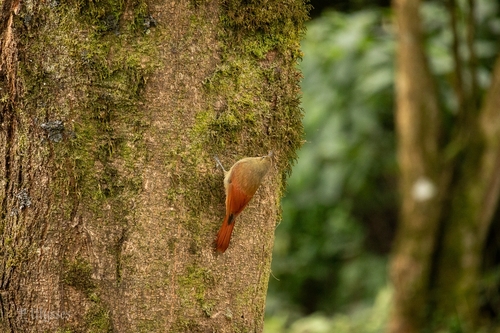
Olivaceous Woodcreeper (Sittasomus griseicapillus) Olivaceous Woodcreeper

Media

Loading…

In short

The Middle American Leaftosser and the Olivaceous Woodcreeper can be distinguished primarily by their structure and behavior. The Leaftosser has a shorter, more robust bill and a distinctive foraging style, while the Woodcreeper has a longer, slender bill and climbs tree trunks like a typical woodcreeper.

Identification tips

Size

Both species are similar in size, but the Olivaceous Woodcreeper may appear slightly larger due to its elongated body and tail.

Plumage

Both species have generally brown plumage, but the Middle American Leaftosser tends to be darker and more uniform, while the Olivaceous Woodcreeper may show subtle streaking and a slightly paler underbelly.

Behaviour

The Middle American Leaftosser is often seen on the ground, tossing leaves aside in search of insects. In contrast, the Olivaceous Woodcreeper is typically seen climbing vertically on tree trunks, using its stiff tail for support.

Habitat

Both species inhabit forested areas, but the Middle American Leaftosser is more often found in dense understory, while the Olivaceous Woodcreeper is more arboreal, frequenting mid to upper levels of the forest.

Voice

The Olivaceous Woodcreeper's vocalizations vary geographically but generally include a trilled song or a series of whistles. The Middle American Leaftosser's vocalizations are less well-documented but are not known to include such trills or whistles.

Submit a better description

Use the same sections as the comparison. Your text is published immediately.

The Middle American Leaftosser and the Olivaceous Woodcreeper can be distinguished primarily by their structure and behavior. The Leaftosser has a shorter, more robust bill and a distinctive foraging style, while the Woodcreeper has a longer, slender bill and climbs tree trunks like a typical woodcreeper.

  • Bill shape: Look for the shorter, more robust bill of the Leaftosser versus the longer, slender bill of the Woodcreeper.
  • Foraging behavior: Observe if the bird is tossing leaves on the ground (Leaftosser) or climbing tree trunks (Woodcreeper).
  • Plumage tone: Note the darker, more uniform brown of the Leaftosser compared to the potentially streaked appearance of the Woodcreeper.
  • Habitat level: Check if the bird is in dense understory (Leaftosser) or higher in the trees (Woodcreeper).

Both species are similar in size, but the Olivaceous Woodcreeper may appear slightly larger due to its elongated body and tail.

Both species have generally brown plumage, but the Middle American Leaftosser tends to be darker and more uniform, while the Olivaceous Woodcreeper may show subtle streaking and a slightly paler underbelly.

The Middle American Leaftosser is often seen on the ground, tossing leaves aside in search of insects. In contrast, the Olivaceous Woodcreeper is typically seen climbing vertically on tree trunks, using its stiff tail for support.

Both species inhabit forested areas, but the Middle American Leaftosser is more often found in dense understory, while the Olivaceous Woodcreeper is more arboreal, frequenting mid to upper levels of the forest.

The Olivaceous Woodcreeper's vocalizations vary geographically but generally include a trilled song or a series of whistles. The Middle American Leaftosser's vocalizations are less well-documented but are not known to include such trills or whistles.

Discard your changes?

You have unsaved edits. If you leave now, those changes will be lost.

Middle American Leaftosser · Olivaceous Woodcreeper · My Tricky Birds