Military Macaw vs Great Green Macaw
Ara militaris versus Ara ambiguus
Play a quiz with Military Macaw and Great Green Macaw
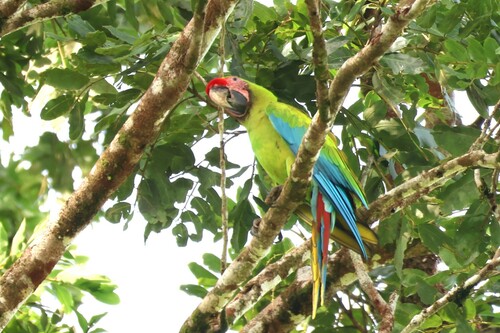
Military Macaw
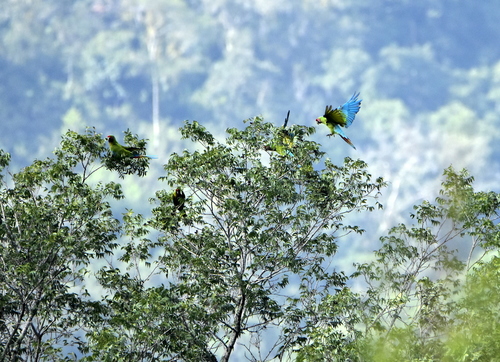
Great Green Macaw
In short
The Great Green Macaw (Ara ambiguus) and the Military Macaw (Ara militaris) are both large, colorful parrots, but they differ significantly in plumage coloration, size, and vocalizations. The Great Green Macaw features a more vibrant green body with distinct red and blue markings, while the Military Macaw has a more subdued green with a prominent red forehead and less pronounced coloration overall.
Identification tips
- Birds of the World Similar-Species Diagnostics:
-
The Great Green Macaw is distinguished from the Military Macaw by its larger size, more vibrant green plumage with blue wing feathers, and a prominent red frontal area. The Military Macaw has a more subdued color palette, exhibiting a red forehead and less vibrant overall coloration (Birds of the World).
-
AI Field Diagnostics:
- Size: Look for overall size; the Great Green Macaw is noticeably larger than the Military Macaw.
- Plumage: Pay attention to the color intensity. The Great Green Macaw's striking green and blue contrast is more vivid than the Military Macaw's olive green tones. The red forehead of the Military Macaw is a key identifier; it can be an easy reference point in the field.
- Behavior: Observe their social behavior; the Great Green Macaw is often seen in smaller groups, while the Military Macaw may be found in larger flocks. Flight patterns can also help, as the Great Green Macaw tends to glide more often.
- Vocalization: If you hear their calls, the Great Green Macaw’s harsh squawks tend to be more piercing compared to the deeper, varied calls of the Military Macaw.
- Habitat Preference: Note the habitat. If you are in a lowland tropical rainforest, you are more likely to encounter a Great Green Macaw, whereas Military Macaws can be found in varied habitats, including mountainous areas.
By taking into account these distinctive features, birdwatchers can more confidently identify and differentiate between the Great Green Macaw and the Military Macaw in the field.
Size
- Great Green Macaw: Typically measures about 80-90 cm (31-35 inches) in length. They have a robust body and long, pointed tail feathers that contribute to their impressive wingspan.
- Military Macaw: Slightly smaller, measuring about 65-75 cm (26-30 inches). Their body is also well-proportioned but has a more compact appearance compared to the Great Green Macaw.
Plumage
- Great Green Macaw: This species has a bright green plumage overall, with a large red frontal area on the forehead and blue wing feathers. Underwing feathers can also show a vibrant blue hue.
- Military Macaw: While primarily green, the Military Macaw has a less vivid coloration. It features a red forehead that extends down to the upper beak. The wings are predominantly green with some blue, but they lack the striking color contrast of the Great Green Macaw.
Behaviour
- Great Green Macaw: Known for their social nature, they often forage in pairs or small groups. Their flight is strong, characterized by steady wingbeats and occasional glides.
- Military Macaw: Also social, Military Macaws can be seen in larger flocks. Their foraging behavior can be quite vocal, and they are known for their acrobatic skills while maneuvering through branches.
Habitat
- Great Green Macaw: Prefers humid tropical rainforests and is often found in lowland areas. They are more commonly associated with the northern regions of South America.
- Military Macaw: Inhabits a wider range of environments, including semi-arid regions and subtropical areas. They are often found in the foothills of the Andes and other mountainous regions in South America.
Voice
- Great Green Macaw: Their calls are loud and resonant, often described as a series of harsh squawks or screams that can be heard over great distances.
- Military Macaw: Their vocalizations are also loud, but they tend to have a slightly different quality, with a more varied range of sounds that can include deeper squawks and whistles.