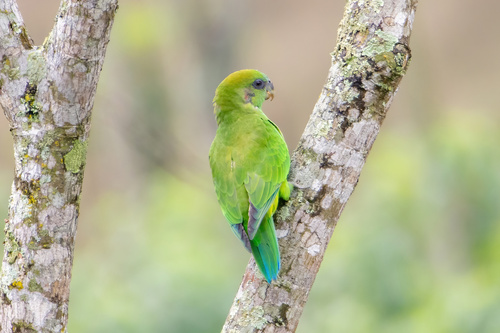
Monk Parakeet vs Pileated Parrot
Myiopsitta monachus versus Pionopsitta pileata
Play a quiz with Monk Parakeet and Pileated Parrot

Monk Parakeet
Pileated Parrot
In short
The Monk Parakeet is easily recognized by its unique nest-building behavior and social nature, often seen in large colonies. The Pileated Parrot is more solitary and can be identified by its distinct red forehead and crown. Both species are small parrots, but their behaviors and plumage are key differentiators.
Identification tips
- Look for the large communal nests of Monk Parakeets, often on utility poles.
- Note the red forehead and crown of the Pileated Parrot, absent in Monk Parakeets.
- Observe behavior: Monk Parakeets are in flocks, while Pileated Parrots are more solitary.
- Listen for the loud chatter of Monk Parakeets compared to the softer calls of Pileated Parrots.
Size
Both species are small parrots, but the Monk Parakeet is slightly larger and bulkier than the Pileated Parrot.
Plumage
Monk Parakeets have a predominantly green plumage with a grayish face and chest. In contrast, Pileated Parrots are also green but feature a striking red forehead and crown, which is absent in Monk Parakeets.
Behaviour
Monk Parakeets are highly social, often seen in large, noisy flocks and known for building large, communal stick nests. Pileated Parrots are more solitary or found in pairs and do not exhibit communal nesting behavior.
Habitat
Monk Parakeets adapt well to urban environments and are often found in parks and cities, building nests on man-made structures. Pileated Parrots prefer forested areas and are less likely to be found in urban settings.
Voice
Monk Parakeets are known for their loud, chattering calls, often heard in urban areas. Pileated Parrots have a more subdued vocalization, typically consisting of softer calls.