Birdr

Morelet's Seedeater vs Black-faced Grassquit

Sporophila morelleti versus Melanospiza bicolor

Play a quiz with Morelet's Seedeater and Black-faced Grassquit
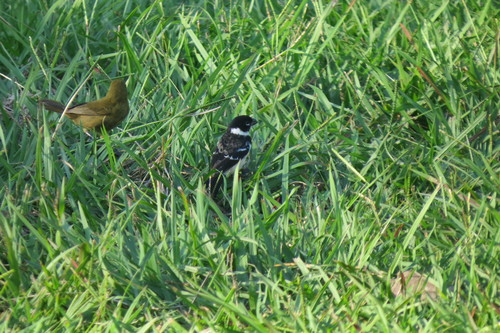
Morelet's Seedeater (Sporophila morelleti) Morelet's Seedeater
Black-faced Grassquit (Melanospiza bicolor) Black-faced Grassquit

Media

Loading…

In short

Morelet's Seedeater and Black-faced Grassquit can be tricky to distinguish, especially females and juveniles. The most reliable difference is the male Morelet's Seedeater's striking black-and-white plumage, while the Black-faced Grassquit male is more uniformly dark with a black face. Both species are small seed-eaters, but they differ in habitat preferences and some vocalizations.

Identification tips

Size

Both species are small, similarly sized finches.

Plumage

Male Morelet's Seedeater is black-and-white, with a clear contrast, while the male Black-faced Grassquit is more uniformly dark with a black face. Females and juveniles of both species are more challenging, as they are generally brownish and less distinct.

Behaviour

Morelet's Seedeater males are often seen singing conspicuously, while females are more secretive. Black-faced Grassquits are generally more uniform in behavior, with less sexual dimorphism in behavior.

Habitat

Morelet's Seedeater prefers savannas, pastures, and brushy fields near water, primarily in the Rio Grande Valley and Central America. Black-faced Grassquit is more adaptable, found in a variety of open and semi-open habitats, often in the Caribbean.

Voice

Morelet's Seedeater males are frequently observed singing from March to October, but specific song differences are not detailed. Black-faced Grassquit has a simple, repetitive song, but without specific details, vocalization comparison remains uncertain.

Submit a better description

Use the same sections as the comparison. Your text is published immediately.

Morelet's Seedeater and Black-faced Grassquit can be tricky to distinguish, especially females and juveniles. The most reliable difference is the male Morelet's Seedeater's striking black-and-white plumage, while the Black-faced Grassquit male is more uniformly dark with a black face. Both species are small seed-eaters, but they differ in habitat preferences and some vocalizations.

  • Male plumage: Look for the stark black-and-white contrast in Morelet's Seedeater males.
  • Female and juvenile plumage: Both species are brownish and similar; focus on context and habitat.
  • Habitat: Consider the environment; Morelet's Seedeater is more likely near water in savanna-like areas, while Black-faced Grassquit can be found in a broader range of open habitats.
  • Behavior: Note the singing behavior of Morelet's Seedeater males during breeding season.

Both species are small, similarly sized finches.

Male Morelet's Seedeater is black-and-white, with a clear contrast, while the male Black-faced Grassquit is more uniformly dark with a black face. Females and juveniles of both species are more challenging, as they are generally brownish and less distinct.

Morelet's Seedeater males are often seen singing conspicuously, while females are more secretive. Black-faced Grassquits are generally more uniform in behavior, with less sexual dimorphism in behavior.

Morelet's Seedeater prefers savannas, pastures, and brushy fields near water, primarily in the Rio Grande Valley and Central America. Black-faced Grassquit is more adaptable, found in a variety of open and semi-open habitats, often in the Caribbean.

Morelet's Seedeater males are frequently observed singing from March to October, but specific song differences are not detailed. Black-faced Grassquit has a simple, repetitive song, but without specific details, vocalization comparison remains uncertain.

Discard your changes?

You have unsaved edits. If you leave now, those changes will be lost.

Morelet's Seedeater · Black-faced Grassquit · My Tricky Birds