Birdr

Mottled Spinetail vs Common Swift

Telacanthura ussheri versus Apus apus

Play a quiz with Mottled Spinetail and Common Swift
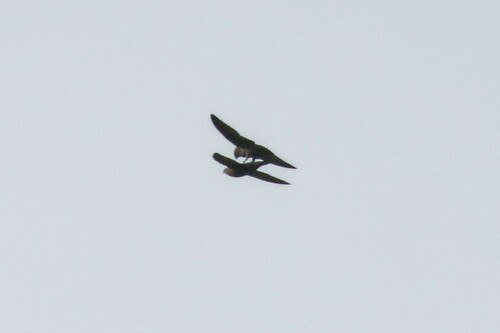
Mottled Spinetail (Telacanthura ussheri) Mottled Spinetail
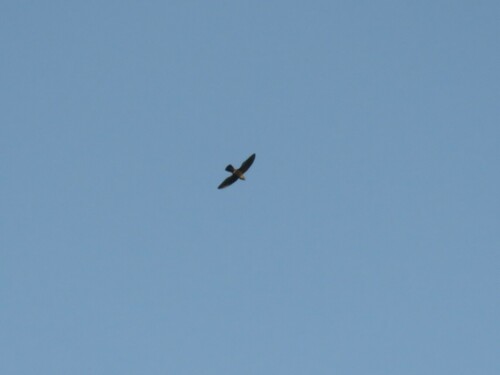
Common Swift (Apus apus) Common Swift

Media

Loading…

In short

The Mottled Spinetail (Telacanthura ussheri) is a smaller, less vocal bird with distinctive plumage patterns and a more varied diet primarily consisting of ants and small insects. In contrast, the Common Swift (Apus apus) is larger, highly aerial, and predominantly insectivorous, known for its long-distance migration and distinctive flight behavior.

Identification tips

  1. Birds of the World Similar-Species Diagnostics:
  2. "Mottled Spinetail is a medium-sized spinetail with a notable pale-mottled throat, while the Common Swift is a large swift with a long, forked tail and sharply pointed wings" (Birds of the World).
  3. "Common Swift is easily distinguished by its larger size, deeply forked tail, and overall black-brown plumage with a pale throat patch" (Birds of the World).

  4. AI Field Diagnostics:

  5. Size and Shape: Look for the Mottled Spinetail's smaller size (14 cm) and a more compact body compared to the Common Swift's larger (16-18 cm) and more elongated body.
  6. Plumage Details: The Mottled Spinetail has a more complex coloration with a pale-mottled throat that contrasts with its darker body, while the Common Swift has a more uniform coloration with a distinctive off-white throat patch.
  7. Behavior: The Mottled Spinetail is generally more elusive and can often be seen in pairs or small groups, while the Common Swift is highly social and often found in larger flocks, especially during migration.
  8. Flight Style: Observe the flight patterns; the Common Swift is known for its fast, agile aerial maneuvers, while the Mottled Spinetail may appear more fluttering and less sustained in flight.
  9. Habitat Preferences: If found in a wide range of habitats and high in the sky, it’s likely the Common Swift. Conversely, the Mottled Spinetail may be associated with more localized foraging areas and is less likely to be seen in open airspace.

These tips should assist birdwatchers in quickly identifying these two species in the field, taking into account their distinctive characteristics and behaviors.

Size

Plumage

Behaviour

Habitat

Voice

Submit a better description

Use the same sections as the comparison. Your text is published immediately.

The Mottled Spinetail (Telacanthura ussheri) is a smaller, less vocal bird with distinctive plumage patterns and a more varied diet primarily consisting of ants and small insects. In contrast, the Common Swift (Apus apus) is larger, highly aerial, and predominantly insectivorous, known for its long-distance migration and distinctive flight behavior.

  1. Birds of the World Similar-Species Diagnostics:
  2. "Mottled Spinetail is a medium-sized spinetail with a notable pale-mottled throat, while the Common Swift is a large swift with a long, forked tail and sharply pointed wings" (Birds of the World).
  3. "Common Swift is easily distinguished by its larger size, deeply forked tail, and overall black-brown plumage with a pale throat patch" (Birds of the World).

  4. AI Field Diagnostics:

  5. Size and Shape: Look for the Mottled Spinetail's smaller size (14 cm) and a more compact body compared to the Common Swift's larger (16-18 cm) and more elongated body.
  6. Plumage Details: The Mottled Spinetail has a more complex coloration with a pale-mottled throat that contrasts with its darker body, while the Common Swift has a more uniform coloration with a distinctive off-white throat patch.
  7. Behavior: The Mottled Spinetail is generally more elusive and can often be seen in pairs or small groups, while the Common Swift is highly social and often found in larger flocks, especially during migration.
  8. Flight Style: Observe the flight patterns; the Common Swift is known for its fast, agile aerial maneuvers, while the Mottled Spinetail may appear more fluttering and less sustained in flight.
  9. Habitat Preferences: If found in a wide range of habitats and high in the sky, it’s likely the Common Swift. Conversely, the Mottled Spinetail may be associated with more localized foraging areas and is less likely to be seen in open airspace.

These tips should assist birdwatchers in quickly identifying these two species in the field, taking into account their distinctive characteristics and behaviors.

  • Mottled Spinetail: Measures approximately 14 cm in length with a weight range of 33 g (male) to 34.5 g (female).
  • Common Swift: Larger, measuring between 16-18 cm in length and weighing between 31-52 g, with a wingspan of 42-48 cm, indicating a more robust body structure designed for agile flight.
  • Mottled Spinetail: Features black-brown upperparts and underparts, with a pale-mottled throat and ventral area. The tail is prominent and appears rounded when spread, square when closed, with rectrix spines extending beyond the web.
  • Common Swift: Displays a more uniform black-brown plumage with a slightly off-white throat patch. The tail is long and deeply forked with sharply pointed wings that contribute to its aerodynamic shape.
  • Mottled Spinetail: Generally silent, often seen in pairs or small groups, exhibiting a more fleeting presence. It is highly mobile, frequently associating with other swifts and hirundines.
  • Common Swift: Known for its remarkable aerial lifestyle, spending more than 99% of its non-breeding period in flight. It is highly social, often seen in larger flocks and displays strong migratory behavior.
  • Mottled Spinetail: Prefers specific habitats where it can forage for its diet of winged ants and small insects. It can often be found in pairs or small groups, indicating a more localized habitat preference.
  • Common Swift: Occupies a wide range of habitats, from arid regions to temperate zones, and is adapted to live at various elevations. Its presence is often correlated with climate and insect availability.
  • Mottled Spinetail: Characterized by rhythmic calls such as “titititititi-rrit” and longer calls that can be described as “shree-shree-skii-skirrrrrreeeee.”
  • Common Swift: Vocalizations are less documented in the provided information but known to be more varied in the context of breeding and social interactions.

Discard your changes?

You have unsaved edits. If you leave now, those changes will be lost.

Mottled Spinetail · Common Swift · My Tricky Birds