
Mountain Hawk-Eagle vs Grey-faced Buzzard
Nisaetus nipalensis versus Butastur indicus
Play a quiz with Mountain Hawk-Eagle and Grey-faced Buzzard
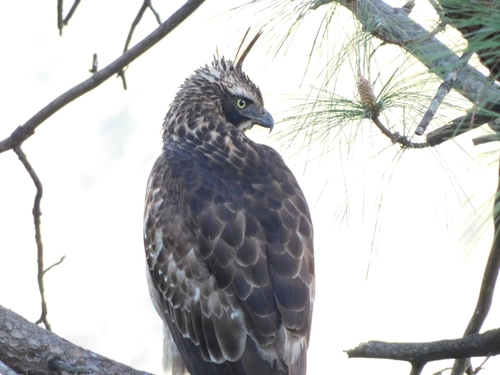 Mountain Hawk-Eagle
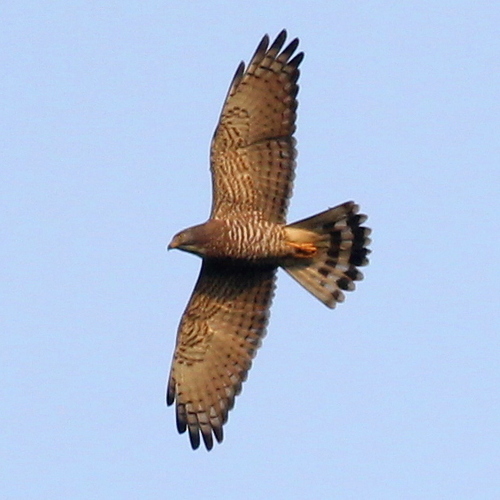 Grey-faced Buzzard
In short
The most reliable field mark to separate Mountain Hawk-Eagle and Grey-faced Buzzard, especially in flight, is overall structure: the Hawk-Eagle is much larger, bulkier, with broad, rounded wings and a prominent head and crest, while the Buzzard is distinctly smaller, with long, narrow, pointed wings and a proportionally smaller head. Juvenile plumages can be confusing, but the Hawk-Eagle juvenile shows a plain tawny underside and a scaled effect above, while the Buzzard juvenile is pale below with brown streaks and a bold white supercilium. Adults are also easily separated by head pattern and underpart barring. Always consider size and jizz first, then check for the crest and head shape, and finally look for plumage details if views allow.
Identification tips
- Size and structure: Mountain Hawk-Eagle is much larger and bulkier than Grey-faced Buzzard. If you see both together, the Hawk-Eagle dwarfs the Buzzard. Use this as your first check, especially in flight or perched at a distance.
- Wing shape in flight: Hawk-Eagle has broad, rounded wings with bulging secondaries and a prominent head/neck; Buzzard has long, narrow, pointed wings, giving a more falcon-like silhouette. This is especially noticeable in soaring or gliding birds.
- Crest: Hawk-Eagle always shows a prominent black crest (with a buffy or white tip depending on age), visible both perched and in flight. Buzzard lacks a crest entirely—its head is smooth and rounded.
- Head pattern (adults): Adult Hawk-Eagle has a rusty head with bold black streaks and a rufous collar effect; Buzzard adult has a clean grey head, breast, and neck, with a white throat and black moustachial/mesial stripes. The Buzzard's face is more sharply patterned and lacks the Hawk-Eagle's streaking.
- Juvenile underparts: Juvenile Hawk-Eagle is plain buffy/tawny below (no barring or streaks); juvenile Buzzard is pale below with brown streaks. If you see a plain, unstreaked underside, it's a Hawk-Eagle juvenile; streaked or barred, it's a Buzzard.
- Supercilium (juveniles): Buzzard juveniles have a broad white supercilium and brown face, giving a 'masked' look. Hawk-Eagle juveniles lack a strong supercilium and have a more uniform, streaked crown and nape.
- Upperwing pattern (juveniles): Hawk-Eagle juveniles show a scaled effect above from pale feather edges and tawny mid-wing patches; Buzzard juveniles are more uniformly brown and mottled, lacking a strong scaled look.
- Tail pattern: Hawk-Eagle tail is grey-brown with obscure blackish bands and a whitish tip (both ages); Buzzard tail is ashy brown with clear horizontal bars (adults and juveniles). Buzzard's tail barring is usually more distinct.
- Underwing pattern: Adult Hawk-Eagle has rusty wing linings with dusky mottling and blackish bars on greyish secondaries; Buzzard adult has brown bars on white underwings. Juvenile Hawk-Eagle has more buff/tawny below and blackish wing-tips; Buzzard juvenile is paler with streaks.
- Eye color: Adult Hawk-Eagle has golden to yellow-orange eyes; juveniles have pale bluish-grey to pale yellow eyes. Buzzard adults have bright yellow irises, juveniles brown with buff.
- Perched posture: Hawk-Eagle sits upright, often with crest raised and a powerful, thick-legged stance. Buzzard perches more horizontally, with a sleeker, smaller profile and no crest.
- Leg feathering: Hawk-Eagle has heavily feathered legs (hence 'feather-toed'); Buzzard's legs are less feathered and appear slimmer.
- Bill and feet: Hawk-Eagle has a larger, more robust bill and thicker feet; Buzzard's bill and feet are proportionally smaller and finer.
- Habitat context: In dense mountain forest, expect Hawk-Eagle; in open woodland, forest edge, or agricultural land, Buzzard is more likely.
- Flight style: Hawk-Eagle's flight is heavy, with shallow beats and glides, wings often held in a shallow V; Buzzard is lighter, with more agile, buoyant flight and pointed wings.
Size
Mountain Hawk-Eagle is a large raptor, substantially bigger and bulkier than Grey-faced Buzzard. The Hawk-Eagle's size is closer to a large buteo or small eagle, with a powerful build and broad wings, while the Buzzard is a small raptor (41–46 cm), much more slender and compact. In direct comparison, the Buzzard will look noticeably smaller, lighter, and more agile, with a shorter, slimmer bill and smaller feet. This size difference is obvious even at a distance or in mixed raptor flocks.
Plumage
-
Juveniles: Mountain Hawk-Eagle juveniles are dark brown above with clear cream to whitish feather edges giving a scaled look, and a plain buffy to tawny underside (no barring or streaking), with a black crest tipped white. Their tail is thinly banded brown with a whitish tip. In contrast, Grey-faced Buzzard juveniles are brown and mottled above, pale below with brown streaks (not plain), and have a broad white supercilium and brown face. Their underparts are streaked, not plain, and the face is more patterned.
-
Adults: Mountain Hawk-Eagle adults are dark brown above, rusty on the head with bold black streaks, and have a black crest with a buffy tip. The underparts are boldly barred rufous on white, with a contrastingly marked throat and malar area. The tail is grey-brown with obscure blackish bands. Grey-faced Buzzard adults have a grey head, breast, and neck, white throat, black moustachial and mesial stripes, brown back and wings, and brown bars on white underparts and underwings. The Buzzard's head is clean grey with a striking white throat and black facial markings, while the Hawk-Eagle's head is rusty and streaked, with a prominent crest.
-
In flight: Hawk-Eagle shows broad, rounded wings with bulging secondaries and a prominent head/crest; adults have rusty wing linings and barred secondaries. Juveniles have more buff/tawny below and blackish wing-tips. Buzzards have pointed, narrow wings with translucent flight feathers, and adults show brown bars on white underwings; juveniles are paler below with streaks, not bars.
Behaviour
Mountain Hawk-Eagle is powerful and agile, often soaring with wings in a shallow V or gliding with strong, shallow wingbeats and level wings. Its flight is heavy and maneuverable, with a prominent head and short, rounded wings. Grey-faced Buzzard is lighter and more buoyant, with quick, agile flight, often seen gliding or soaring on narrow, pointed wings. The Buzzard's flight is less powerful, more falcon-like, and the bird appears more streamlined and less bulky. Perched, the Hawk-Eagle sits upright with a raised crest, while the Buzzard appears smaller, with a sleeker profile and no crest.
Habitat
Both species are Asian raptors, but Mountain Hawk-Eagle is associated with forested mountains and foothills, often in the Himalayas and similar upland regions. Grey-faced Buzzard breeds in temperate East Asia (Manchuria, Korea, Japan) and winters in Southeast Asia, often in open woodland, forest edges, or agricultural areas. In overlap zones, context can help: a large raptor deep in mountain forest is more likely a Hawk-Eagle, while a smaller raptor in open or edge habitats could be a Buzzard.