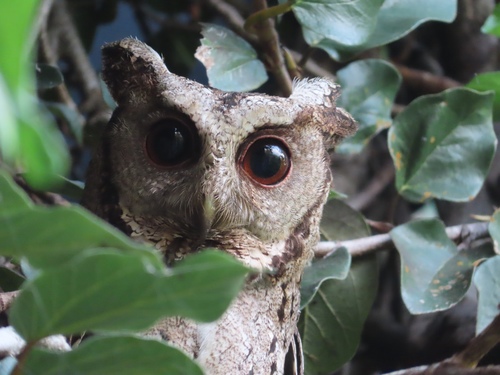
Mountain Scops Owl vs Collared Scops Owl
Otus spilocephalus versus Otus lettia
Play a quiz with Mountain Scops Owl and Collared Scops Owl
Mountain Scops Owl
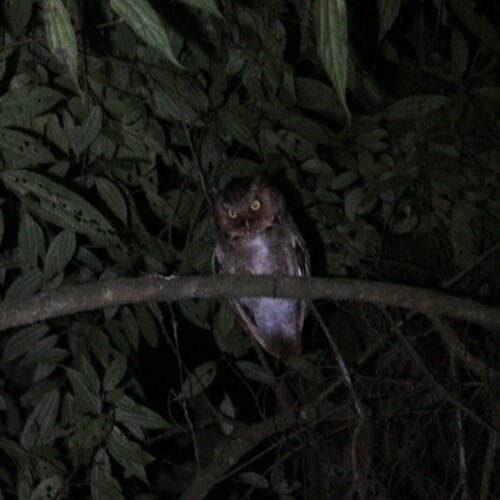
Collared Scops Owl
In short
The Mountain Scops Owl (Otus spilocephalus) and Collared Scops Owl (Otus lettia) can be tricky to differentiate due to their similar size and structure. However, the Mountain Scops Owl typically has a more pronounced supercilium and a distinct facial disk pattern. Vocalizations are also a key differentiator, with each species having unique calls.
Identification tips
- Supercilium and facial disk: Look for the more pronounced supercilium and facial disk pattern in Mountain Scops Owl.
- Vocalizations: Pay attention to the distinct calls of each species, especially during the breeding season.
- Habitat: Consider the habitat, with Mountain Scops Owl more likely in montane areas.
- Lighting and individual variation: Be aware of lighting conditions and individual plumage variations that can affect appearance.
Size
Both species are similar in size, typical of small scops owls, making size an unreliable field mark.
Plumage
The Mountain Scops Owl often shows a more distinct supercilium and facial disk pattern compared to the Collared Scops Owl. The Collared Scops Owl may have a more uniform coloration, but this can vary with individual and lighting conditions.
Behaviour
Both species exhibit similar nocturnal behaviors, often roosting quietly during the day and becoming active at dusk. Behavioral differences are subtle and not reliable for field identification.
Habitat
Mountain Scops Owls are typically found in montane forests, while Collared Scops Owls prefer a wider range of habitats, including lowland forests and urban areas. Overlapping ranges can occur, so habitat alone is not definitive.
Voice
The Mountain Scops Owl has a distinctive call that differs from the Collared Scops Owl's more typical scops owl hoots. Listening for these vocal differences is crucial for identification.