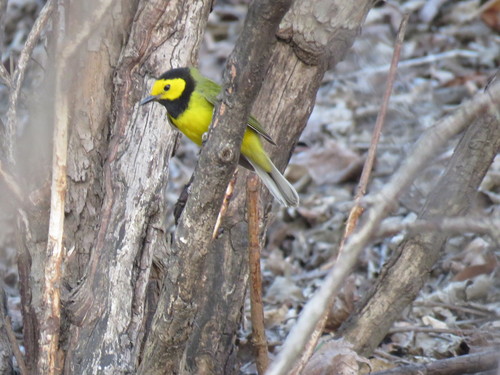
Mourning Warbler vs Hooded Warbler
Geothlypis philadelphia versus Setophaga citrina
Play a quiz with Mourning Warbler and Hooded Warbler
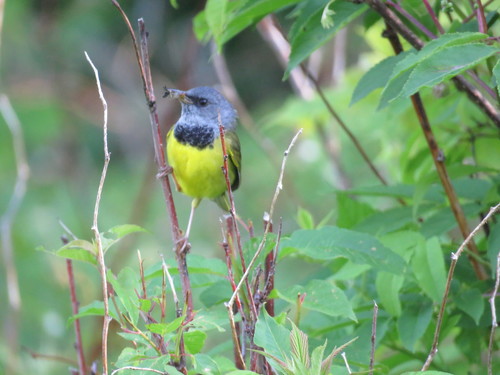
Mourning Warbler
Hooded Warbler
In short
Mourning Warbler and Hooded Warbler can be distinguished by their plumage and behavior. The Mourning Warbler lacks the Hooded Warbler's distinctive black hood and white tail spots, while the Hooded Warbler is known for its tail-flicking behavior that reveals white spots. Both species are New World warblers, but they have different habitat preferences and vocalizations.
Identification tips
- Look for the black hood and white tail spots in the Hooded Warbler.
- Observe the tail-flicking behavior of the Hooded Warbler.
- Note the gray hood and lack of tail spots in the Mourning Warbler.
- Consider habitat: Hooded Warblers are often in forest gaps, while Mourning Warblers prefer dense undergrowth.
- Listen for song differences, but be cautious of variability and overlap.
Size
Both species are small warblers, similar in size, with no significant differences in structure that are easily observable in the field.
Plumage
The Mourning Warbler has a gray hood and lacks the white tail spots seen in the Hooded Warbler. The Hooded Warbler features a striking black hood in males and white spots on the outer tail feathers, which are visible when the bird flicks its tail.
Behaviour
The Hooded Warbler frequently flicks its tail to reveal white spots, a behavior not observed in the Mourning Warbler. The Mourning Warbler tends to be more secretive and skulking.
Habitat
Mourning Warblers prefer dense, shrubby areas in forests, while Hooded Warblers are "gap specialists," favoring forest edges or gaps with dense understory. The Hooded Warbler's range is expanding northward, unlike the Mourning Warbler.
Voice
The songs of these species differ, with the Mourning Warbler having a more complex and varied song compared to the Hooded Warbler's simpler, repetitive song. However, song can be variable and may overlap in areas of hybridization.