Birdr

Mourning Warbler vs Olive-crowned Yellowthroat

Geothlypis philadelphia versus Geothlypis semiflava

Play a quiz with Mourning Warbler and Olive-crowned Yellowthroat
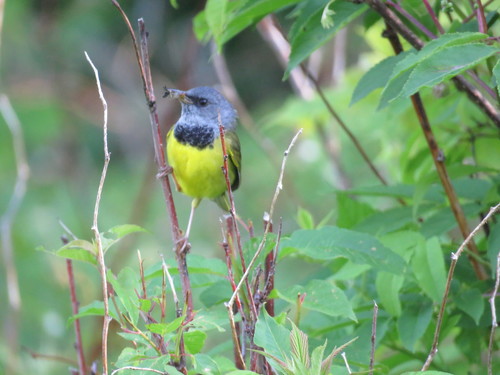
Mourning Warbler (Geothlypis philadelphia) Mourning Warbler
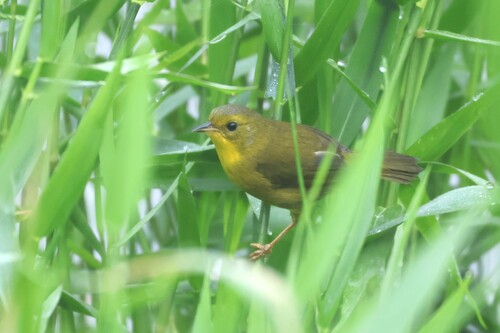
Olive-crowned Yellowthroat (Geothlypis semiflava) Olive-crowned Yellowthroat

Media

Loading…

In short

The Mourning Warbler and Olive-crowned Yellowthroat can be distinguished by plumage and habitat preferences. Mourning Warblers have a more muted appearance with a gray hood and olive back, while Olive-crowned Yellowthroats are brighter with uniformly yellow underparts and green upperparts. Habitat preferences also differ, with Mourning Warblers favoring dense understories and Olive-crowned Yellowthroats found in more open, grassy areas.

Identification tips

Size

Both species are small warblers, but size differences are subtle and not reliable for field identification.

Plumage

Mourning Warblers have a gray hood and olive back, with males showing a black patch on the chest. Olive-crowned Yellowthroats are brighter, with uniformly yellow underparts and green upperparts. Males lack a gray upper border to the face mask, unlike some other yellowthroats.

Behaviour

Both species are often secretive and skulk in dense vegetation, but Olive-crowned Yellowthroats may be more visible in open areas.

Habitat

Mourning Warblers prefer dense, shrubby understories, often in regenerating forests. Olive-crowned Yellowthroats are found in open, grassy areas and marshes, often near water.

Voice

Vocalizations are not well-documented in the provided notes, but Mourning Warblers have a distinct song that differs from the Olive-crowned Yellowthroat's calls.

Submit a better description

Use the same sections as the comparison. Your text is published immediately.

The Mourning Warbler and Olive-crowned Yellowthroat can be distinguished by plumage and habitat preferences. Mourning Warblers have a more muted appearance with a gray hood and olive back, while Olive-crowned Yellowthroats are brighter with uniformly yellow underparts and green upperparts. Habitat preferences also differ, with Mourning Warblers favoring dense understories and Olive-crowned Yellowthroats found in more open, grassy areas.

  • Plumage: Look for the gray hood and olive back of the Mourning Warbler versus the bright yellow and green of the Olive-crowned Yellowthroat.
  • Habitat: Note the habitat; Mourning Warblers are in dense shrubs, while Olive-crowned Yellowthroats prefer open, grassy areas.
  • Behavior: Mourning Warblers are more likely to be hidden in dense cover, whereas Olive-crowned Yellowthroats might be seen in more open spaces.

Both species are small warblers, but size differences are subtle and not reliable for field identification.

Mourning Warblers have a gray hood and olive back, with males showing a black patch on the chest. Olive-crowned Yellowthroats are brighter, with uniformly yellow underparts and green upperparts. Males lack a gray upper border to the face mask, unlike some other yellowthroats.

Both species are often secretive and skulk in dense vegetation, but Olive-crowned Yellowthroats may be more visible in open areas.

Mourning Warblers prefer dense, shrubby understories, often in regenerating forests. Olive-crowned Yellowthroats are found in open, grassy areas and marshes, often near water.

Vocalizations are not well-documented in the provided notes, but Mourning Warblers have a distinct song that differs from the Olive-crowned Yellowthroat's calls.

Discard your changes?

You have unsaved edits. If you leave now, those changes will be lost.

Mourning Warbler · Olive-crowned Yellowthroat · My Tricky Birds