Birdr

Namaqua Dove vs Malagasy Coucal

Oena capensis versus Centropus toulou

Play a quiz with Namaqua Dove and Malagasy Coucal
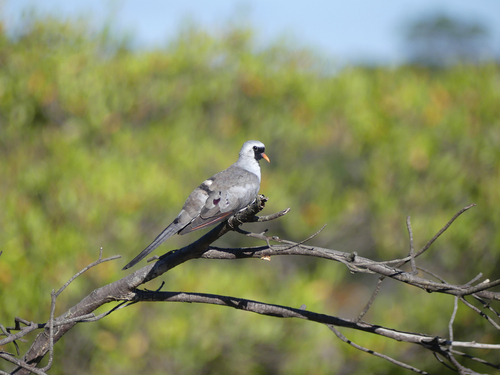
Namaqua Dove (Oena capensis) Namaqua Dove
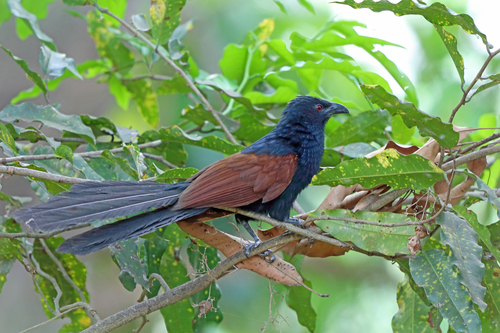
Malagasy Coucal (Centropus toulou) Malagasy Coucal

Media

Loading…

In short

The Namaqua Dove is a small, slender dove with a distinctive long tail, while the Malagasy Coucal is a larger, more robust bird with a heavy bill and a shorter tail. These species differ significantly in size, structure, and habitat preferences, making them distinguishable in the field.

Identification tips

1. Size and Structure: Look for the smaller size and long tail of the Namaqua Dove compared to the larger, heavier Malagasy Coucal. 2. Plumage: Note the black face and throat of male Namaqua Doves versus the dark head and rufous body of the Malagasy Coucal. 3. Behavior: Observe the habitat; Namaqua Doves are in open areas, while Malagasy Coucals are in dense vegetation. 4. Vocalizations: Listen for the dove's soft cooing compared to the coucal's deep calls.

Size

Namaqua Dove is much smaller and more delicate than the larger, bulkier Malagasy Coucal.

Plumage

Namaqua Dove has a distinctive black face and throat in males, with a long, pointed tail and a generally pale body. The Malagasy Coucal has a dark head, neck, and back with a rufous-brown body and a shorter, rounded tail.

Behaviour

Namaqua Doves are often seen walking on the ground in open areas, while Malagasy Coucals are more likely to be found skulking in dense vegetation.

Habitat

Namaqua Dove prefers open, arid environments and can be found near water sources, whereas the Malagasy Coucal inhabits dense, wooded areas and is more associated with humid environments.

Voice

Namaqua Dove has a soft, mournful cooing, while the Malagasy Coucal produces a series of deep, resonant calls.

Submit a better description

Use the same sections as the comparison. Your text is published immediately.

The Namaqua Dove is a small, slender dove with a distinctive long tail, while the Malagasy Coucal is a larger, more robust bird with a heavy bill and a shorter tail. These species differ significantly in size, structure, and habitat preferences, making them distinguishable in the field.

1. Size and Structure: Look for the smaller size and long tail of the Namaqua Dove compared to the larger, heavier Malagasy Coucal. 2. Plumage: Note the black face and throat of male Namaqua Doves versus the dark head and rufous body of the Malagasy Coucal. 3. Behavior: Observe the habitat; Namaqua Doves are in open areas, while Malagasy Coucals are in dense vegetation. 4. Vocalizations: Listen for the dove's soft cooing compared to the coucal's deep calls.

Namaqua Dove is much smaller and more delicate than the larger, bulkier Malagasy Coucal.

Namaqua Dove has a distinctive black face and throat in males, with a long, pointed tail and a generally pale body. The Malagasy Coucal has a dark head, neck, and back with a rufous-brown body and a shorter, rounded tail.

Namaqua Doves are often seen walking on the ground in open areas, while Malagasy Coucals are more likely to be found skulking in dense vegetation.

Namaqua Dove prefers open, arid environments and can be found near water sources, whereas the Malagasy Coucal inhabits dense, wooded areas and is more associated with humid environments.

Namaqua Dove has a soft, mournful cooing, while the Malagasy Coucal produces a series of deep, resonant calls.

Discard your changes?

You have unsaved edits. If you leave now, those changes will be lost.

Namaqua Dove · Malagasy Coucal · My Tricky Birds