Birdr

Namaqua Sandgrouse vs Yellow-throated Sandgrouse

Pterocles namaqua versus Pterocles gutturalis

Play a quiz with Namaqua Sandgrouse and Yellow-throated Sandgrouse
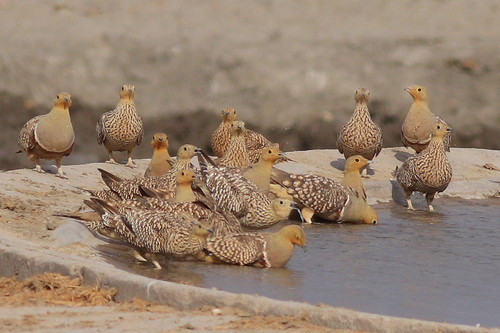
Namaqua Sandgrouse (Pterocles namaqua) Namaqua Sandgrouse
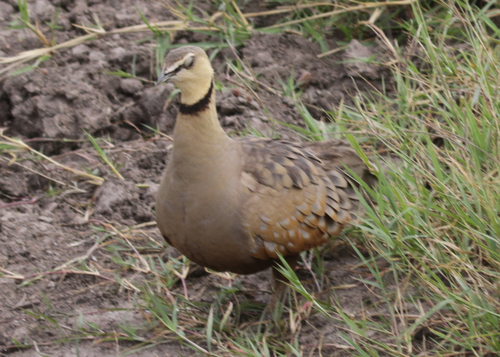
Yellow-throated Sandgrouse (Pterocles gutturalis) Yellow-throated Sandgrouse

Media

Loading…

In short

Namaqua Sandgrouse and Yellow-throated Sandgrouse are both members of the Pteroclidae family, but they can be distinguished by their plumage and vocalizations. Namaqua Sandgrouse is generally more uniform in color, while Yellow-throated Sandgrouse has distinctive yellow throat markings.

Identification tips

Size

Both species are similar in size, typical of sandgrouse, with no significant difference in overall body size.

Plumage

Namaqua Sandgrouse has a more uniform sandy-brown plumage with subtle barring, whereas Yellow-throated Sandgrouse features a striking yellow throat patch and more contrasting plumage patterns.

Behaviour

Both species exhibit similar behaviors typical of sandgrouse, such as ground foraging and flying in flocks, with no notable behavioral differences highlighted.

Habitat

Both species inhabit arid and semi-arid regions, but Namaqua Sandgrouse is more commonly found in open, sandy areas, while Yellow-throated Sandgrouse may be found in slightly more vegetated regions.

Voice

Vocalizations differ, with Namaqua Sandgrouse having a softer, more repetitive call, while Yellow-throated Sandgrouse produces a louder, more varied call. Specific vocal details are not well-documented.

Submit a better description

Use the same sections as the comparison. Your text is published immediately.

Namaqua Sandgrouse and Yellow-throated Sandgrouse are both members of the Pteroclidae family, but they can be distinguished by their plumage and vocalizations. Namaqua Sandgrouse is generally more uniform in color, while Yellow-throated Sandgrouse has distinctive yellow throat markings.

  • Look for the yellow throat: Yellow-throated Sandgrouse has a distinctive yellow throat patch, absent in Namaqua Sandgrouse.
  • Check plumage patterns: Namaqua Sandgrouse has more uniform sandy-brown plumage, while Yellow-throated Sandgrouse shows more contrast.
  • Listen for calls: If vocalizations are heard, note that Namaqua Sandgrouse has softer calls compared to the louder calls of Yellow-throated Sandgrouse.
  • Observe habitat: Consider the habitat; Namaqua Sandgrouse prefers open sandy areas, whereas Yellow-throated Sandgrouse may be in more vegetated regions.

Both species are similar in size, typical of sandgrouse, with no significant difference in overall body size.

Namaqua Sandgrouse has a more uniform sandy-brown plumage with subtle barring, whereas Yellow-throated Sandgrouse features a striking yellow throat patch and more contrasting plumage patterns.

Both species exhibit similar behaviors typical of sandgrouse, such as ground foraging and flying in flocks, with no notable behavioral differences highlighted.

Both species inhabit arid and semi-arid regions, but Namaqua Sandgrouse is more commonly found in open, sandy areas, while Yellow-throated Sandgrouse may be found in slightly more vegetated regions.

Vocalizations differ, with Namaqua Sandgrouse having a softer, more repetitive call, while Yellow-throated Sandgrouse produces a louder, more varied call. Specific vocal details are not well-documented.

Discard your changes?

You have unsaved edits. If you leave now, those changes will be lost.

Namaqua Sandgrouse · Yellow-throated Sandgrouse · My Tricky Birds