Birdr

New Zealand Grebe vs Little Pied Cormorant

Poliocephalus rufopectus versus Microcarbo melanoleucos

Play a quiz with New Zealand Grebe and Little Pied Cormorant

New Zealand Grebe (Poliocephalus rufopectus) New Zealand Grebe
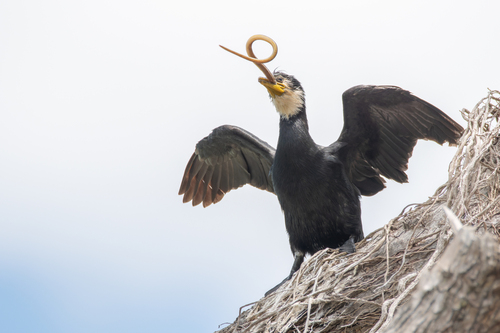
Little Pied Cormorant (Microcarbo melanoleucos) Little Pied Cormorant

Media

Loading…

In short

The most reliable field mark to differentiate the New Zealand Grebe from the Little Pied Cormorant is their overall structure: the grebe is smaller and more compact with a shorter neck and bill, while the cormorant is larger with a longer neck and distinctively hooked bill. Both species can be found in aquatic habitats, but their behavior and posture can help in identification.

Identification tips

Look for the size and structure: the grebe is smaller with a shorter neck and bill, while the cormorant is larger with a longer neck and hooked bill. Observe behavior: grebes dive frequently, while cormorants may be seen drying their wings.

Size

The New Zealand Grebe is smaller and more compact compared to the larger Little Pied Cormorant.

Plumage

New Zealand Grebe has a more uniform plumage with no stark black and white contrast, unlike the Little Pied Cormorant which has a distinctive black and white coloration.

Behaviour

New Zealand Grebes are often seen diving frequently and staying submerged for longer periods, while Little Pied Cormorants may be observed drying their wings with a characteristic spread-wing posture.

Submit a better description

Use the same sections as the comparison. Your text is published immediately.

The most reliable field mark to differentiate the New Zealand Grebe from the Little Pied Cormorant is their overall structure: the grebe is smaller and more compact with a shorter neck and bill, while the cormorant is larger with a longer neck and distinctively hooked bill. Both species can be found in aquatic habitats, but their behavior and posture can help in identification.

Look for the size and structure: the grebe is smaller with a shorter neck and bill, while the cormorant is larger with a longer neck and hooked bill. Observe behavior: grebes dive frequently, while cormorants may be seen drying their wings.

The New Zealand Grebe is smaller and more compact compared to the larger Little Pied Cormorant.

New Zealand Grebe has a more uniform plumage with no stark black and white contrast, unlike the Little Pied Cormorant which has a distinctive black and white coloration.

New Zealand Grebes are often seen diving frequently and staying submerged for longer periods, while Little Pied Cormorants may be observed drying their wings with a characteristic spread-wing posture.

Discard your changes?

You have unsaved edits. If you leave now, those changes will be lost.

New Zealand Grebe · Little Pied Cormorant · My Tricky Birds