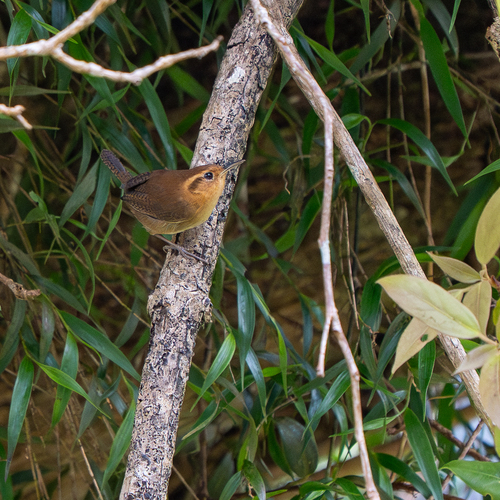
Nightingale Wren vs Ochraceous Wren
Microcerculus philomela versus Troglodytes ochraceus
Play a quiz with Nightingale Wren and Ochraceous Wren

Nightingale Wren
Ochraceous Wren
In short
The Nightingale Wren and Ochraceous Wren can be distinguished by their habitat and behavior. The Nightingale Wren is more often identified by its song and its habit of walking along the forest floor, while the Ochraceous Wren is more arboreal. Both species belong to the wren family but differ in plumage and vocalization.
Identification tips
1. Habitat: Look for Nightingale Wrens on the forest floor in lowland forests; Ochraceous Wrens are more arboreal and found in montane forests. 2. Behavior: Note the Nightingale Wren's ground-dwelling habits and posterior bobbing. 3. Plumage: Dark brown with black-tipped feathers for Nightingale Wren; ochre tones and distinct supercilium for Ochraceous Wren. 4. Vocalization: Listen for the Nightingale Wren's complex song, which is a key identifier.
Size
Both species are small wrens, but the Nightingale Wren is generally more compact and has a shorter tail.
Plumage
The Nightingale Wren has dark brown plumage with feathers narrowly tipped with black, giving it a more uniform appearance. In contrast, the Ochraceous Wren has a more ochre or rufous tone, often with a more distinct supercilium.
Behaviour
The Nightingale Wren is known for its terrestrial behavior, often seen walking on the forest floor and bobbing its posterior. The Ochraceous Wren is more likely to be found in the mid to upper levels of the forest, being more arboreal.
Habitat
Nightingale Wrens prefer dense, humid forests and are often found in lowland areas. Ochraceous Wrens are typically found in montane forests and are more common at higher elevations.
Voice
The Nightingale Wren is often identified by its melodious and complex song, which is more frequently heard than the bird is seen. The Ochraceous Wren's song is less complex and more typical of the Troglodytes genus.